
Most traders pick brokers like beginners pick indicators. After checking spreads and commissions, they open the “looks cheapest.”
After six months, they acknowledged their plan’s success. Their action.
Trading full-time makes your broker more than just a place to trade. Your foundation. Fills, slippage, overnight swaps, news margin stability, and capital safety. Everything starts with that decision.
The guide does not list promotional rankings. This trader’s decision-making methodology is built on real execution data, study, and our blunders before we learned what was significant.
If you are looking for the best broker for full-time trading, this is how to evaluate one like a professional.
The Real Cost of Trading Is Not the Spread
Retail traders obsess over a 0.1 pip difference. Professionals obsess over execution quality.
According to the Bank for International Settlements Triennial FX Survey, the forex market trades over $7 trillion per day. That liquidity is deep in major pairs, but depth does not mean your broker routes your orders optimally.
Here is what the data implies for day traders:
Deep liquidity exists. Poor execution is usually a brokerage issue, not a market issue.
The National Bureau of Economic Research found that transaction costs significantly reduce the returns from active trading. Even small hidden costs add up and slow down performance for high-frequency or intraday strategies.
At the same time, regulatory bodies like the Financial Conduct Authority have made brokers under their jurisdiction publish execution statistics and keep up with capital standards. That is more important than a fancy website.
What this really means:
If you trade all the time, your edge is small. Your system will get worse without you determining why if your average trade anticipates is 0.3R and your broker adds inconsistent slippage or widens broadens when the market is very volatile.
In real life, the cheapest broker is often the one that costs the most on paper.
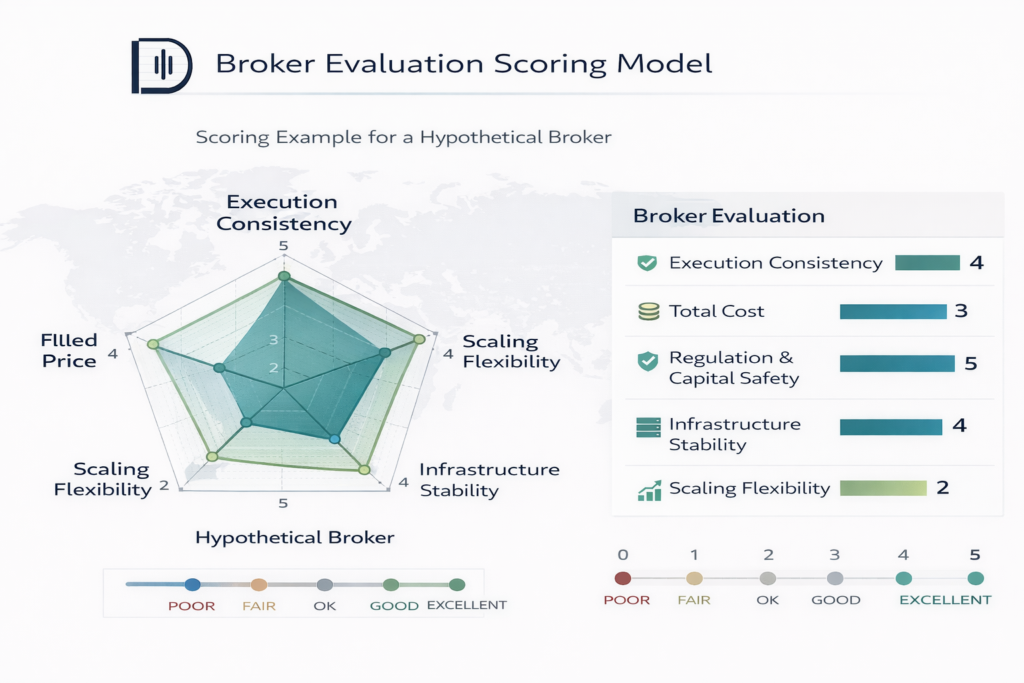
Ranking What Actually Matters
This is how I rank brokers for full-time trading:
Consistency in execution
The real cost of everything
Rules and protecting capital
Stability of infrastructure
Scaling flexibility
Notice expansions don’t come first. They are part of the cost, but not all of it.
Let’s break this down like a serious trader would.
Execution Quality: The Invisible Edge
Execution is where most “good strategies” go to die.
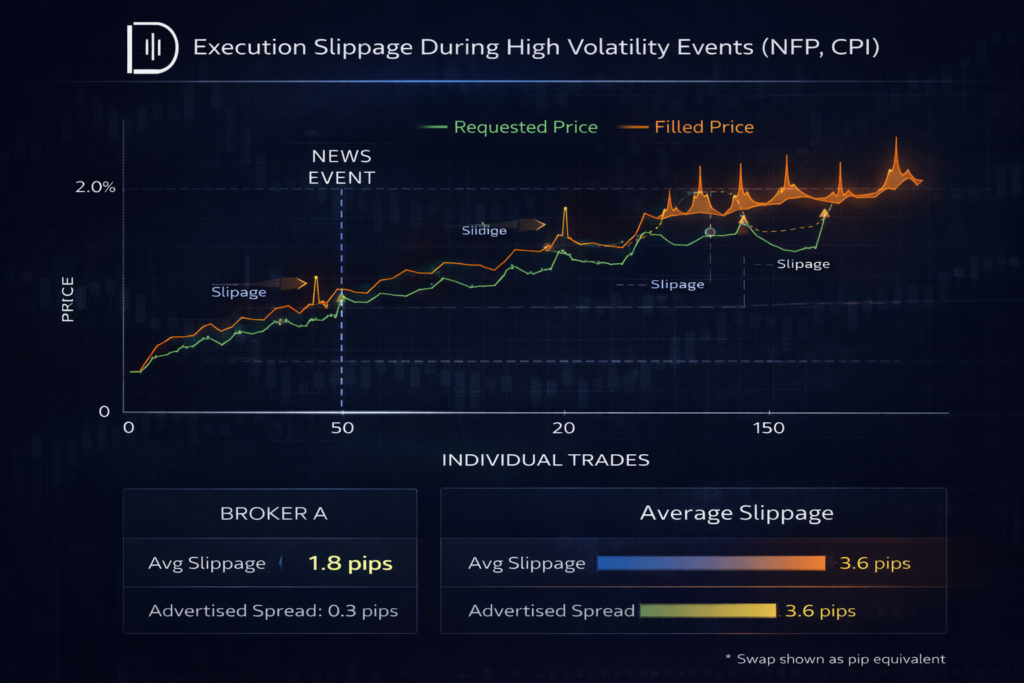
Two brokers might both say that the average spread on EURUSD is 0.2 pips. One always fills within 0.1 pip of the asked price. The other one gives you 0.3 to 0.5 pips when the market is moving quickly.
If you trade breakouts, that difference will tell you if your R multiple holds.
Excellent test framework:
Two practice accounts. For big events that cause a lot of volatility, like the London open or US data releases, place the same market orders. Write down 50 requests for trades and their fill prices. Check for deviation.
Then look at micro accounts with low balances. Sometimes, live execution is different from demo fills.
Speed and slippage control are more critical than raw spread when trading momentum-driven news or setups. Slippage and order execution tactics were covered in our DayTradersDiary.com article.
Full-time traders must think in terms of execution reliability, not marketing metrics.
True Cost: Spread Plus Commission Plus Swap Plus Slippage
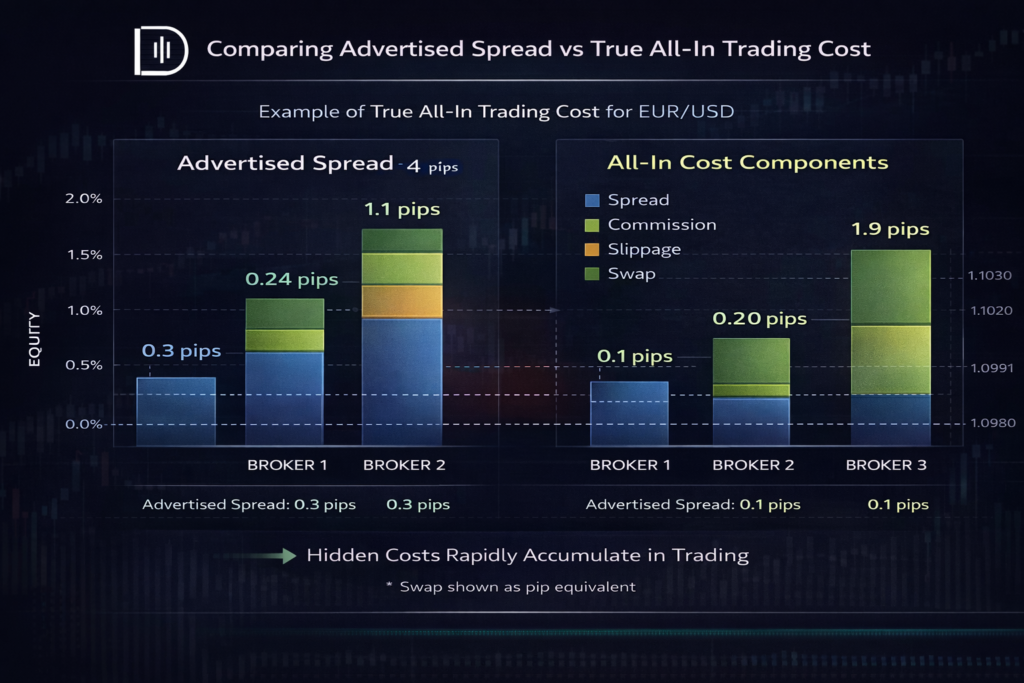
Because they only look at the spread, most traders get the cost of trading wrong.
The right formula for full-time evaluation is:
The all-in cost is the spread plus the commission plus the average slippage plus the effect of overnight financing.
If you only trade during the day, swaps don’t matter as much. If you swing trade for a living, financing becomes significant.
Some ECN-style brokers say they have tight spreads, but they charge commissions that make the total cost higher than well-structured accounts that don’t charge commissions.
This is when keeping a journal becomes very useful. If you don’t keep track of your entry price, exit price, and effective cost per trade, you’re just guessing. Instead of relying on platform summaries, our Trade Journal Template on DayTradersDiary.com helps you figure this out correctly.
Dashboards are not trusted by professionals. They check their own performance.
Regulation and Capital Safety
If you trade full-time, your income depends on how stable your broker is.
Regulated brokers in Tier-1 jurisdictions like the Financial Conduct Authority must keep client money separate and have capital buffers. That doesn’t get rid of risk, but it does cut down on counterparty exposure by a lot compared to lightly regulated offshore firms.
When the amount in your account is equal to months of income, protecting your capital is no longer an afterthought; it’s a strategic variable.
Think about this:
Does the broker stay stable if volatility goes up and spreads widen quickly?
Do they change the amount of leverage they give you overnight without telling you?
Have they ever stopped trading during events that had a big effect?
Full-time traders need to think about the worst-case scenarios, not the best-case marketing promises.
Infrastructure and Platform Stability
If you trade five days a week, the platform needs to be stable.
When servers go down during big events, it costs more than any difference in commission. This is why serious traders test:
Platform uptime during big releases
Execution during rollover
Chart stability when there are a lot of ticks
If you scalp or trade lower timeframes, latency matters. VPS solutions can reduce delay, but they cannot fix poor broker-side infrastructure.
In our article on building a professional trading routine on DayTradersDiary.com, we discussed how infrastructure becomes part of your edge. Your broker is part of that system.
A Practical Decision Framework
To choose the finest full-time broker, I advise traders:
Determine your strategy profile.
Looking for 5–10 pips as a scalper?
A momentum-building breakout trader?
A 1–3-hour session trader?
An intraday swing hybrid that holds overnight?
Second, simulate cost impact.
If your average trade focus on is 8 pips and your all-in cost is 1.2 pips, that means that 15% of your gross profit is lost to friction. If another broker lowers that to 0.8 pips, your chances of winning go up a lot.
Third, test stress conditions.
Trade during NFP. Trade during the CPI. Trade when the market is unstable. Watch how people act.
Fourth, check the limits on scaling.
Does the broker handle bigger lot sizes without making the spreads bigger? Can you divide orders without them going up and down? Many brokers do well when they are small, but not when they are big.
The size of your account today doesn’t matter for full-time trading. It’s about tomorrow.
Risk Management and Broker Selection
Most traders get their risk calculations wrong here.
They figure out risk based on the theoretical stop distance, but they don’t take into account execution variation.
If your broker makes entries by 0.3 pips and exits by 0.3 pips, your real risk is higher than your planned risk.
Using a position size calculator removes guesswork. On DayTradersDiary.com, our Position Size Calculator helps incorporate realistic pip values and account risk parameters so you are not underestimating exposure.
Your broker affects your risk model. If you change brokers, retest your risk metrics.
Edge preservation starts with accurate sizing.
Journaling Broker Performance
Very few traders keep separate records of how well their broker does and how well their trades do.
You should keep an eye on:
Average slippage for each session
Spread behavior at different times of day
Execution quality during news
Orders that were turned down or requoted
Create a monthly broker performance review inside your trade journal. Over 200 trades, patterns emerge.
Our downloadable Trade Journal Template is structured so you can add execution and cost columns easily. If you treat your broker like a black box, you will never diagnose subtle performance decay.
Professionals measure everything.
Scaling Beyond Personal Capital
There is another dimension most retail traders ignore.
Even if you find the best forex broker for full-time trading, capital constraints limit income potential.
This is why a lot of serious traders use programs like The5ers, FTMO, or FundingPips to evaluate their trades.
This isn’t about taking the easy way out. It’s about making the most of your money.
If your strategy makes 5% a month with controlled risk, moving from a $10,000 account to a $200,000 funded account modifications the structure of your income in a big way.
The logic is simple:
Edge plus discipline without sufficient capital caps growth.
Evaluation accounts allow you to deploy skill on larger buying power without personal capital concentration risk.
The5ers in particular offers programs with lower time pressure compared to some competitors, which suits disciplined traders who do not want to force trades to meet deadlines.
If you already have a proven strategy and reliable journal data, setting up a The5ers evaluation account could be a smart next step in making your trading business more competent.
The broker is the layer that carries out your orders. The prop firm is now your partner in capital.
So Who Is the Best Broker for Full-Time Trading
The truth is that it depends.
The best broker for scalpers is the one that can handle a lot of stress and still get the job done.
For session traders, it is the one with stable spreads and minimal platform disruption.
For hybrid traders, it is the one with competitive swaps and margin stability.
The best broker is not universal. It is strategy dependent.
What is universal is this:
Full-time traders must evaluate brokers with data, not marketing.
Frequently Asked Questions
When choosing a forex broker for full-time trading, what is the most important thing to think about?
Execution consistency is more important than the spreads that are shown. The quality of order routing and slippage have a direct effect on expectancy.
Do active traders always do better with ECN brokers?
Not always. Adding spreads and slippage to some commission-based accounts makes them more expensive. Always figure out the total cost.
Should full-time traders stay away from brokers in other countries?
When you trade full-time, it’s important to keep your money safe and follow the rules. Strong regulatory environments lower the risk of a counterparty.
How do I properly check broker execution?
Run two live micro accounts at the same time, keep track of requested and filled prices, and compare the data from at least 50 to 100 trades in different levels of volatility.
Is it better to use a prop firm than to build up your own capital?
Yes, for a lot of traders. If you already have a proven edge, evaluation programs let you scale without putting all your money into one place.
Final Reflection
Here is your challenge if you want to trade full time.
Check your broker’s work for 30 days.
Keep an eye on slippage. Watch how the spread changes. Find out the real cost. Look over the execution under stress.
Before looking into infrastructure, most traders blame strategy.
Don’t do that.
Improve one thing this month. Either tighten your broker evaluation process or refine your execution tracking.
Then read our guide on building a resilient trading business on DayTradersDiary.com and treat your trading like the professional operation it is meant to be.