
Traders think their problem is their strategy.
No, it’s not.
They change indicators and entries, and look for fresh setups, thinking that the next change will improve their performance.
In the meantime, they keep making the same mistakes every week.
Trading too much after a win. Being unsure following a loss. When pressure builds, moving stops.
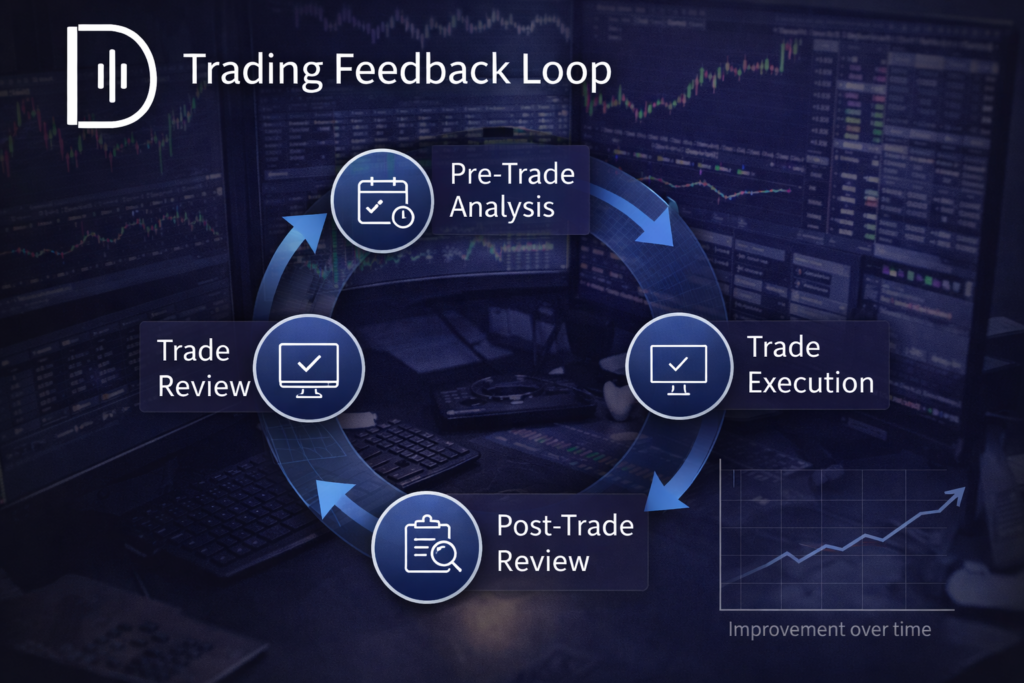
The true problem is easy. They have no feedback loop.
A forex trading journal is not just a record of trades. It is a mirror that shows you exactly how you think, execute, and react under pressure.
Used correctly, it becomes the fastest way to improve without changing your strategy.
What Research Reveals About Journaling in Trading
Tracking performance isn’t just for trading. It is employed in all areas of high performance.
The CME Group cites studies that show that disciplined traders use structured data to improve execution and control risk.
The Bank for International Settlements talked about behavioural research that suggests that decision making gets better when feedback loops are consistent and can be measured. Educational insights from Investopedia emphasize that tracking trades helps identify patterns in both strategy performance and trader behavior.
But here is what most traders miss.
Journaling is not about tracking wins and losses.
It is about tracking decisions.
That distinction changes everything.
What a Forex Trading Journal Actually Is
Most people who are new to journaling think that a journal is a spreadsheet with entries, exits, and profits. That’s only the surface. A real trading logbook has three parts. The deal itself, the reasons for it, and how you felt while doing it. The commerce demonstrates what you did.
The argument explains why you did it. The emotional layer indicates how stress changed the choices you made. Without all three, you are only seeing part of the picture.
A profitable strategy executed with poor discipline will still lose money.
A journal exposes that gap.
The Three Parts of a High Performance Journal
To make journaling useful, it needs structure.
The first part is pre trade analysis.
Before entering a trade, you define the setup, the context, and the expectation.
For example, you might note that EURUSD is breaking resistance during the London session with momentum confirmation.
This forces clarity.
If you cannot explain the trade before entering, you probably should not be in it.
The second part is execution tracking.
This includes entry price, stop loss, position size, and whether you followed your plan.
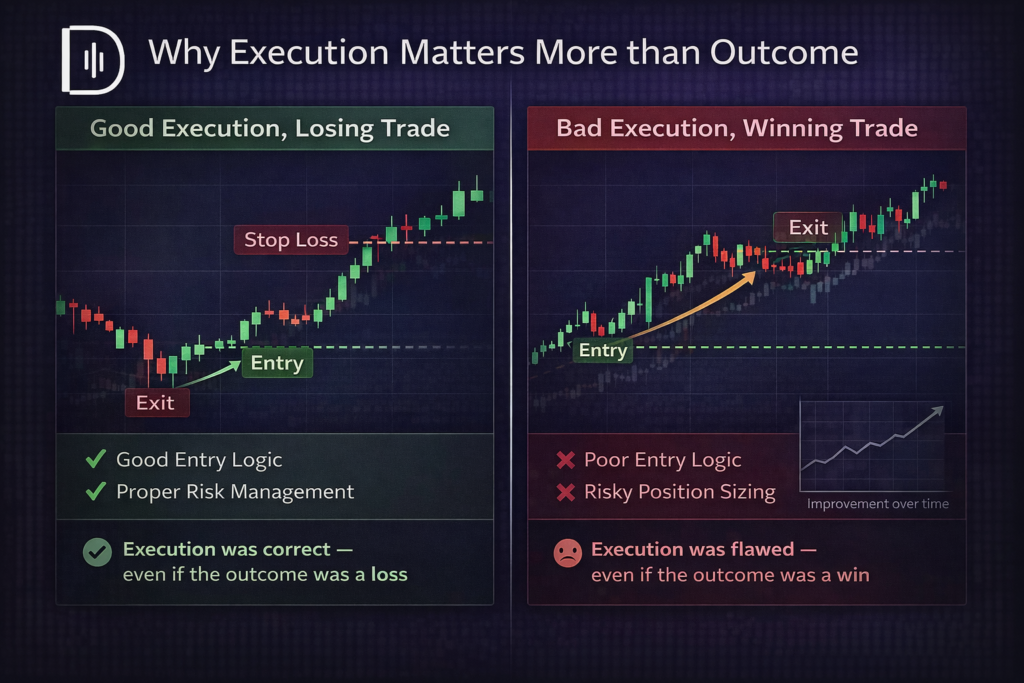
Many traders only track results, but execution quality matters more.
A losing trade executed perfectly is still a good trade.
A winning trade executed poorly is a problem waiting to repeat.
The third part is post trade review.
This is where improvement happens.
You review what actually occurred versus what you expected.
Did the setup behave as anticipated?
Did you exit too early or too late?
Did emotions influence your decisions?
This is where patterns start to emerge.
A Practical Framework for Using a Trading Journal
Journaling becomes powerful when it is consistent and focused.
Start by defining a small number of variables to track.
Do not try to track everything.
Focus on what actually impacts your trading.
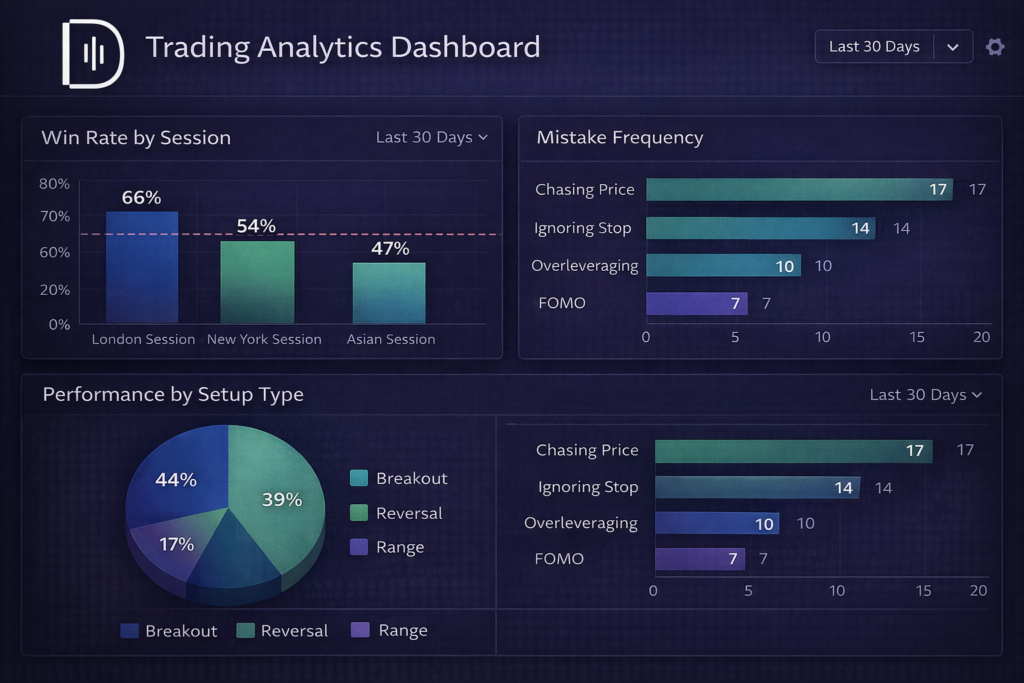
For example, track setup type, session, outcome, and execution quality.
After 20 to 30 trades, review your data.
Look for patterns.
Are your best trades happening during a specific session?
If you have read the DayTradersDiary.com guide on trading the New York session, you know that volatility and momentum can vary significantly across sessions.
Are your losses coming from a specific mistake, like entering too early?
Your journal should answer these questions.
If it does not, you are tracking the wrong things.
The Mistake Most Traders Make With Journaling
Most traders start journaling after losses.
They write more when they are frustrated and less when things are going well.
This creates biased data.
A journal only works if it is consistent.
Every trade gets recorded.
Not just the bad ones.
Another common mistake is overcomplicating the process.
If journaling takes too long, you will stop doing it.
The goal is efficiency.
Capture what matters and move on.
Connecting Journaling to Strategy Improvement
A trading journal is not just for reflection.
It is for refinement.
For example, if your data shows that breakout trades have a lower win rate but higher reward, you can adjust your risk accordingly.
If you notice that trades taken during low liquidity hours perform poorly, you can eliminate them.
This is where journaling connects with strategy.
If you have explored indicators like MACD, the DayTradersDiary.com article on using MACD in day trading explains how momentum plays a role in trade quality.
Your journal can confirm whether those insights apply to your trading.
You move from theory to evidence.
Risk Management Through Journaling
One of the biggest benefits of journaling is understanding risk.
Not just how much you risk, but how consistently you apply it.
Many traders believe they risk 1 percent per trade.
Their journal often reveals otherwise.
They increase size after wins and reduce it after losses.
This inconsistency affects long term results.
This is where most traders miscalculate risk. Using a position size calculator ensures that your risk remains consistent regardless of trade setup.
Your journal then becomes a tool to verify that consistency.
Risk is not what you intend.
It is what you actually execute.
Using the Trade Journal Template Effectively
A structured template removes friction.
Instead of guessing what to track, you follow a predefined system.
The Trade Journal Template on DayTradersDiary.com is designed to capture both technical and psychological aspects of trading.
Use it daily.
Do not wait until the end of the week.
The closer you journal to the trade, the more accurate your insights will be.
Over time, this creates a database of your behavior.
That data is more valuable than any indicator.
Scaling With Data Driven Trading
Once you start journaling consistently, something changes.
You stop guessing.
You start making decisions based on evidence.
That shift is what separates casual traders from professionals.
But even with a solid process, capital becomes a limiting factor.
This is where proprietary trading firms come in.
Firms like The5ers, FTMO, and Topstep evaluate traders based on consistency, discipline, and risk control.
A well maintained trading journal becomes a major advantage in these evaluations.
It shows that you understand your edge and can execute it consistently.
The5ers, in particular, focuses on steady growth and controlled risk, which aligns with traders who rely on structured feedback loops.
If your journal shows consistent performance, exploring a The5ers evaluation account can be a logical next step.
Scaling is not about trading more.
It is about applying a proven process to larger capital.
Frequently Asked Questions
What is a forex trading journal?
A forex trading journal is a structured record of your trades, decisions, and performance used to improve consistency and strategy.
What should I include in my trading journal?
Include information about the deal, why it happened, how well it was done, and how you feel about it.
How often should I review my journal?
Daily for individual trades and weekly for pattern analysis.
Can journaling improve trading results?
Yes, because it reveals patterns in both strategy performance and trader behavior.
Final Thoughts
A trading journal will not make you profitable overnight.
But it will show you exactly why you are not profitable yet.
That clarity is where real progress begins.
For the next two weeks, journal every single trade.
Not just the outcome, but the reasoning and execution.
Then review your last 20 trades and identify one repeating mistake.
Fix that one thing.
If you want to go deeper, the next article to read on DayTradersDiary.com is our guide on building a rule based trading plan.