
Most traders think they are taking one trade.
In reality, they are taking three.
They go long EURUSD, long GBPUSD, and short USDCHF at the same time, believing they are diversifying.
What they are actually doing is stacking the same idea three times.
When the trade works, it feels great.
When it fails, the losses compound quickly.
This is where currency correlations quietly destroy accounts.
Understanding how to trade currency correlations is not about adding complexity. It is about removing hidden risk and using relationships between pairs to improve decision making.
What Research Says About Currency Correlations
Currency correlations measure how pairs move relative to each other.
The Bank for International Settlements and institutional studies reveal that changes in currency are linked because of global capital flows, interest rate expectations, and macroeconomic considerations.
Market insights from the CME Group highlight how major currencies often move in clusters, especially during periods of high liquidity or macro driven trends.
Educational platforms such as Investopedia explain that correlations are not static. They change depending on market conditions, risk sentiment, and economic cycles.
For traders, this leads to a critical understanding.
Correlation is not just a statistic.
It is a reflection of how money flows through the global market.
Understanding Positive and Negative Correlations
At a basic level, correlations fall into two categories.
Positive correlation means two pairs tend to move in the same direction. EURUSD and GBPUSD are a common example.
Negative correlation means two pairs tend to move in opposite directions. EURUSD and USDCHF often show this relationship.
But here is where most traders oversimplify.
Correlation is not constant.
Two pairs can be strongly correlated during one session and diverge during another.
That shift often signals something important.
It can indicate a change in market sentiment or a developing opportunity.
The Hidden Risk of Correlated Trades
One of the biggest mistakes traders make is overexposure.
Taking multiple trades that are highly correlated increases risk without increasing diversification.
For example, going long EURUSD and GBPUSD at the same time is essentially doubling exposure to USD weakness.
If the dollar strengthens unexpectedly, both trades lose.
Professional traders think in terms of exposure, not just individual trades.
Before entering multiple positions, ask yourself.
Are these trades independent or are they expressing the same idea?
If they are the same idea, risk should be adjusted accordingly.
This is where many traders unknowingly violate their own risk rules.
Using Correlations as a Confirmation Tool
One of the most effective ways to trade currency correlations is through confirmation.
Instead of taking a trade based on one pair, look at related pairs to validate the move.
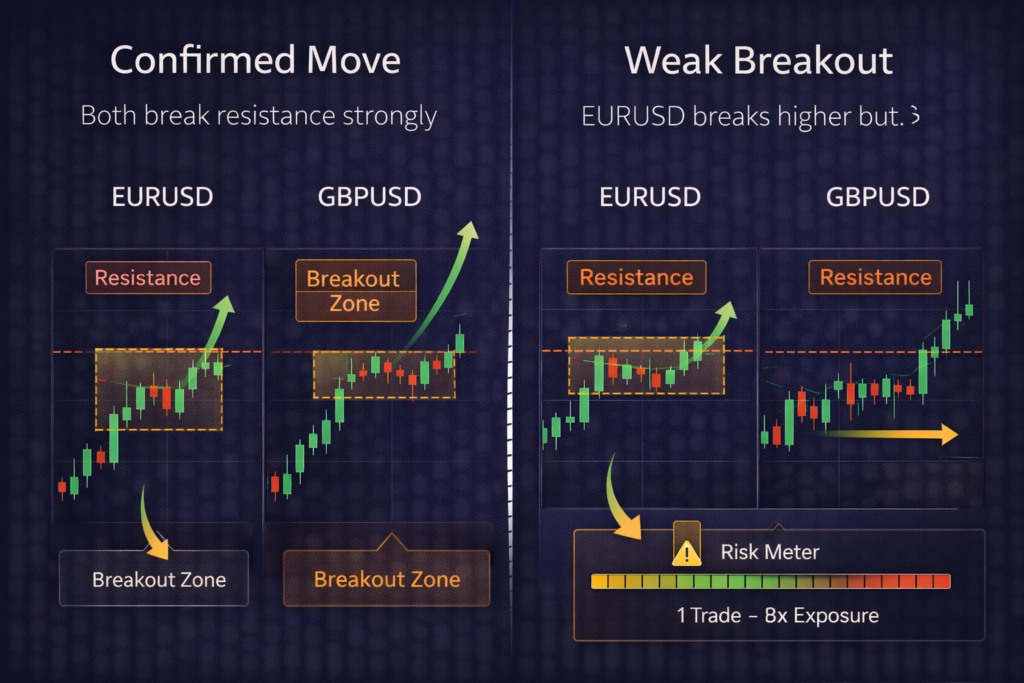
For example, if EURUSD is breaking above resistance during the London session, check GBPUSD.
If both pairs are moving in the same direction, it adds confidence to the trade.
If EURUSD is breaking higher but GBPUSD is weak or stagnant, the breakout may lack strength.
Correlation helps you filter trades.
It does not generate them.
If you already understand session timing, the DayTradersDiary.com guide on trading the London session explains why these confirmations often become clearer during high liquidity periods.
The Divergence Setup Most Traders Miss
While confirmation is useful, divergence is where advanced traders find opportunity.
Divergence occurs when correlated pairs stop moving together.
For example, EURUSD continues trending higher while GBPUSD begins to stall or reverse.
This can signal that the underlying momentum is weakening.
In some cases, divergence leads to mean reversion.
In others, it signals that one pair is about to catch up.
The key is context.
If divergence occurs at a major resistance level, it often increases the probability of reversal.
If it occurs in the middle of a trend, it may simply be temporary imbalance.
Most traders ignore divergence.
Experienced traders watch it closely.
A Practical Framework for Trading Correlations
To apply this in real trading, think in terms of alignment.
Start by identifying your primary setup on one pair.
Then check related pairs.
Are they confirming the move or contradicting it?
If multiple correlated pairs align, you can either increase confidence in a single trade or distribute risk across pairs more carefully.
If they diverge, it may be a warning sign to reduce size or avoid the trade.
For example, if you are planning to short EURUSD during the New York session and USDCHF is not showing strength, the trade may lack confirmation.
If you want to refine your timing further, the DayTradersDiary.com article on forex trading hours explains when correlations tend to strengthen or weaken based on market participation.
When Correlations Break Down
Correlations are not permanent.
They break during major news events, central bank decisions, and shifts in market sentiment.
For example, a strong economic release from the U.S. can cause USD pairs to move aggressively, temporarily overriding normal correlations.
Geopolitical events can also disrupt relationships between currencies.
This is why blind reliance on correlation coefficients can be dangerous.
You are not trading numbers.
You are trading behavior.
Understanding when correlations are reliable and when they are not is part of the edge.
Risk Management With Correlated Trades
Correlation directly impacts risk.
If you take multiple correlated trades, your effective risk increases even if each trade follows your rules individually.
For example, risking 1 percent on three highly correlated trades is not 3 percent diversified risk.
It is more like concentrated exposure. This is where most traders get their risk wrong. A position size calculator lets you change the sizes of your positions so that your total exposure stays under control. You can either lower the size of all the associated transactions or focus on the strongest scenario. Professional traders don’t often layer the same ideas on top of each other.
They control exposure across the whole portfolio. Journaling Correlation Behavior
Most traders do not track correlation in their journal.
This is a missed opportunity.
Your journal should include whether trades were correlated, whether pairs confirmed each other, and how those trades performed.
Over time, patterns emerge.
You may find that trades with multi pair confirmation have higher win rates.
Or that divergence setups perform best under specific conditions.
Using the Trade Journal Template on DayTradersDiary.com allows you to capture these insights and refine your approach.
Correlation is not just a concept.
It is a measurable part of your edge.
Scaling With a Correlation Based Approach
Once you understand correlations, your trading becomes more structured.
You stop overexposing your account and start making more informed decisions.
But scaling that consistency requires capital.
This is where proprietary trading firms come in.
Firms like The5ers, FTMO, and Topstep evaluate traders based on risk control and consistency.
Correlation awareness is a major advantage in these environments because it helps maintain disciplined exposure.
The5ers, in particular, stresses steady growth and controlled drawdowns, which is a good fit for traders who know how to handle correlated risk.
If your trading improves when you factor in correlations, exploring a The5ers evaluation account can be a logical next step.
Edge becomes more powerful when applied to larger capital.
Frequently Asked Questions
What is forex correlation?
Forex correlation demonstrates how two currencies move in relation to each other, either in the same direction or in the opposite direction.
Can you trade multiple correlated pairs?
Yes, but risk should be adjusted to avoid overexposure.
Which pairs are most correlated?
EURUSD and GBPUSD commonly move in the same direction, while EURUSD and USDCHF often move in the other direction.
Do correlations always hold?
No. Correlations change based on market conditions, news events, and shifts in sentiment.
Final Thoughts
Currency correlations are one of the simplest ways to improve trading without changing your strategy.
They help you see the market as a connected system rather than isolated charts.
Most traders focus on entries.
Professionals focus on exposure.
For the next two weeks, track every trade and note whether it was correlated with another position.
You will quickly see patterns in both your wins and losses.
If you want to build on this, the next article to read on DayTradersDiary.com is our guide on managing multiple trades without increasing risk.