
Most traders do not blow accounts because of bad strategies.
They blow them because of one oversized position.
You can have a 60 percent win rate, a clean strategy, and still end up losing money if your risk is inconsistent.
One emotional trade. One revenge entry. One moment of overconfidence.
That is all it takes.
Money management in day trading is not just about protecting capital. It is about controlling your behavior under pressure.
This guide is not theory. It is built on what actually keeps traders in the game long enough to become consistently profitable.
What the Data Says About Trading Risk
The global trading ecosystem is massive, but individual survival rates are low.
According to the CFA Institute, behavioral biases and poor risk control are among the primary reasons traders underperform.
Market data from the Bank for International Settlements shows how volatile and fast moving markets can be, especially in forex where leverage amplifies outcomes.
Educational insights from Investopedia consistently point to risk management as the defining factor between short term traders and long term survivors.
Here is what that means in real terms.
Profitability is not about finding the perfect setup.
It is about surviving long enough for your edge to play out.
The Real Goal of Money Management
Most traders think money management is about maximizing profits.
It is not.
It is about controlling drawdowns.
If you protect your downside, the upside takes care of itself over time.
Think of it this way.
If you lose 50 percent of your account, you need 100 percent return just to recover.
If you limit your drawdown to 10 percent, recovery becomes manageable.
Professional traders focus more on what they can lose than what they can make.
That mindset shift alone changes everything.
The Fixed Risk Per Trade Framework
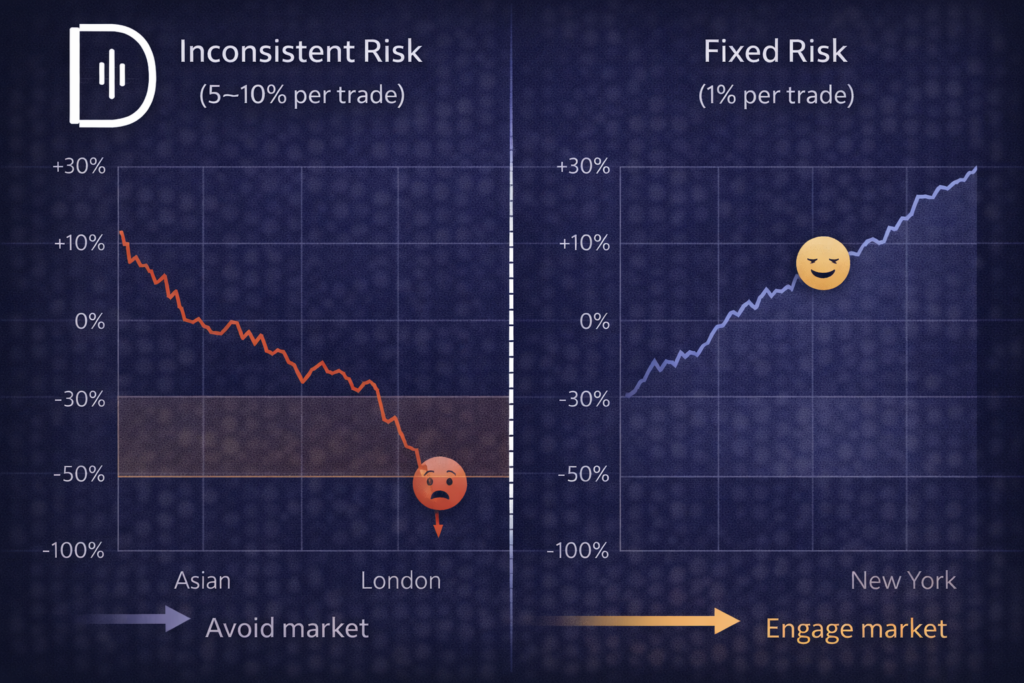
One of the most effective approaches is risking a fixed percentage of your account per trade.
This creates consistency.
If you risk 1 percent per trade, a losing streak does not destroy your account. It simply becomes part of the statistical cycle.
But here is where most traders go wrong.
They say they risk 1 percent, but in reality, their position size changes randomly based on confidence.
A setup that “feels strong” gets more risk.
A setup that feels uncertain gets less.
This inconsistency breaks the system.
Money management only works when it is applied consistently, regardless of emotion.
The Drawdown Control Rule Most Traders Ignore
Every trader experiences losing streaks.
What matters is how you respond to them.
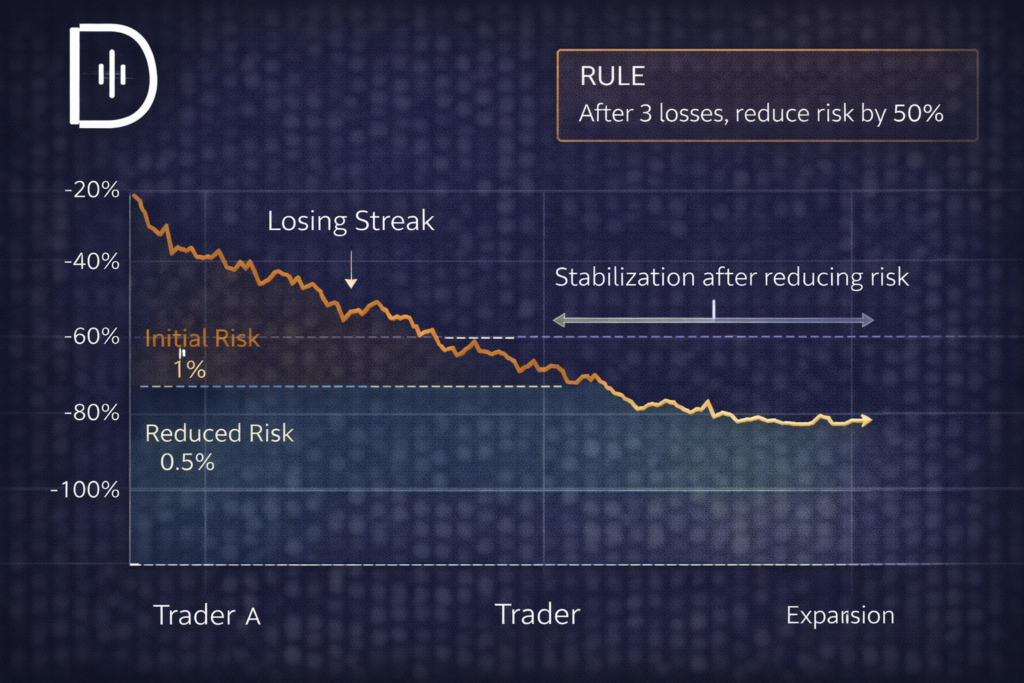
One of the most effective rules is reducing risk after consecutive losses.
For example, after three losing trades, cutting your risk per trade in half can stabilize your equity curve.
This is not about fear.
It is about adaptation.
Markets change. Conditions shift. Your strategy may temporarily lose edge.
Reducing risk during these periods keeps you in the game until conditions improve.
Position Sizing Is Where Most Traders Fail
Entry is easy.
Position sizing is where real discipline shows.
Two traders can take the exact same trade and have completely different outcomes based on how they size their positions.
This is where most traders miscalculate risk. Using a position size calculator removes guesswork and ensures that every trade aligns with your defined risk percentage.
Without this, money management becomes theoretical.
With it, risk becomes controlled and measurable.
The Relationship Between Volatility and Risk
Money management does not exist in isolation.
It must adapt to market conditions.
During high volatility, stop losses need to be wider. During low volatility, they can be tighter.
If you use the same position size in both conditions, your risk becomes inconsistent.
This is why understanding volatility is critical.
If you have read the DayTradersDiary.com guide on how to measure volatility in forex, you know that market conditions directly impact trade structure.
Professional traders adjust position size based on volatility, not just account size.
Why Win Rate Is Less Important Than Risk to Reward
Many traders chase high win rates.
They want to be right most of the time.
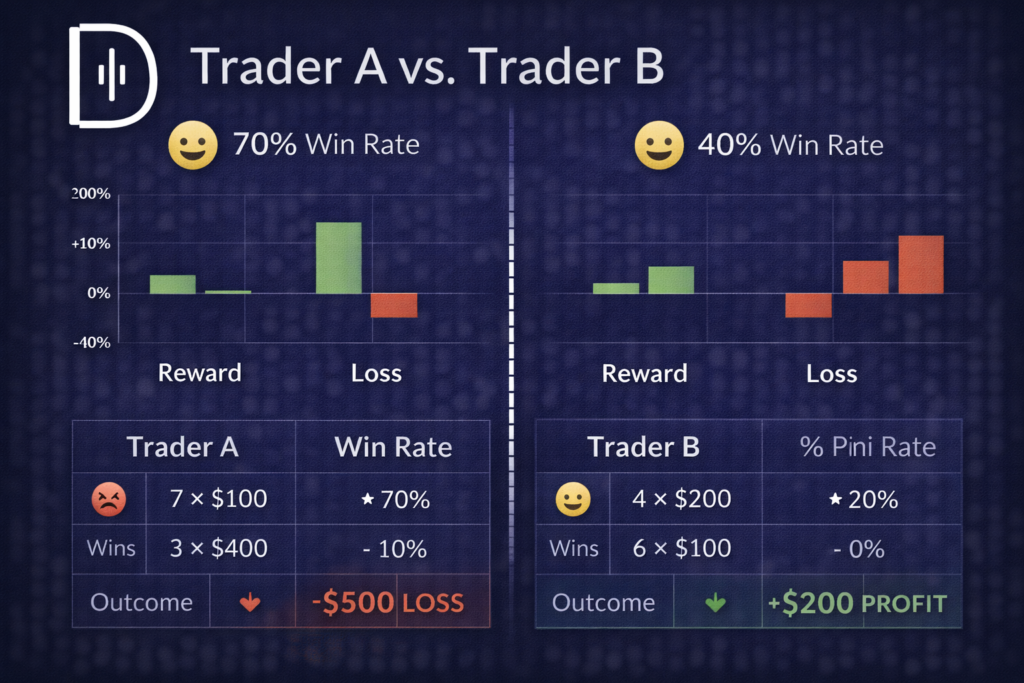
But profitability comes from the relationship between risk and reward.
A trader with a 40 percent win rate can still be profitable if their winning trades are significantly larger than their losses.
On the other hand, a trader with a 70 percent win rate can lose money if losses are too large.
Money management defines this relationship.
It determines whether your strategy has positive expectancy.
The Daily Loss Limit That Protects Your Psychology
One of the most underrated money management rules is the daily loss limit.
This is a predefined amount where you stop trading for the day.
Not pause. Stop.
The purpose is not just financial.
It is psychological.
After a series of losses, decision making deteriorates. Traders become reactive, emotional, and impulsive.
A daily loss limit protects you from yourself.
It creates a boundary where discipline takes over emotion.
Journaling Your Risk, Not Just Your Trades
Most traders write down when they enter and leave a trade. Very few people write down their risky behaviour. You should keep note of how much you risked, if you followed your rules, and how you changed after wins and losses. Patterns show up over time. You may notice that your biggest losses come from breaking position sizing rules rather than bad setups.
Using the Trade Journal Template on DayTradersDiary.com allows you to track these variables and refine your money management approach.
Improvement comes from awareness.
Scaling With Discipline and Capital
Once you develop strong money management habits, consistency improves.
But growth eventually becomes limited by account size.
This is where many disciplined traders look beyond retail accounts.
Proprietary trading firms provide access to larger capital for traders who can demonstrate controlled risk.
Firms like The5ers, FTMO, and Topstep evaluate traders based on consistency, drawdown control, and execution discipline.
In these situations, managing money becomes even more critical. The5ers, for instance, stresses steady development and rigorous risk restrictions, which are in line with traders who already follow organised risk regulations. You can apply the same level of discipline to a larger account if you can handle risk well on a small one. Exploring a The5ers evaluation account can be a logical step once your process is consistent.
Frequently Asked Questions
What is the best money management strategy for day trading?
One of the best ways to manage this is to have a set % risk for each trade, together with strict position sizing and drawdown control.
How much should you risk per trade?
Depending on their strategy and level of experience, many professional traders are willing to risk between 0.5% and 2% of their capital on each deal.
Can you be profitable with a low win rate?
Yes. Profitability depends on risk to reward, not just win rate.
Why do traders fail even with good strategies?
Most failures come from poor risk management, inconsistent position sizing, and emotional decision making.
Final Thoughts
Money management is not the exciting part of trading.
It does not give you the thrill of catching a big move.
But it is the reason some traders survive while others disappear.
For the next two weeks, focus on one thing.
Execute every trade with the exact same risk percentage.
No exceptions.
That single habit will reveal more about your trading than any new strategy.
If you want to go deeper, the next article to read on DayTradersDiary.com is our breakdown of risk to reward ratio and how it shapes long term profitability.