
Most traders learn candlestick patterns the wrong way.
They memorise names.
Doji. Engulfing. Hammer. Shooting star.
Then they go to a live chart, spot one of these patterns, enter a trade, and wonder why it fails half the time.
The problem is not the pattern.The problem is how it is interpreted.
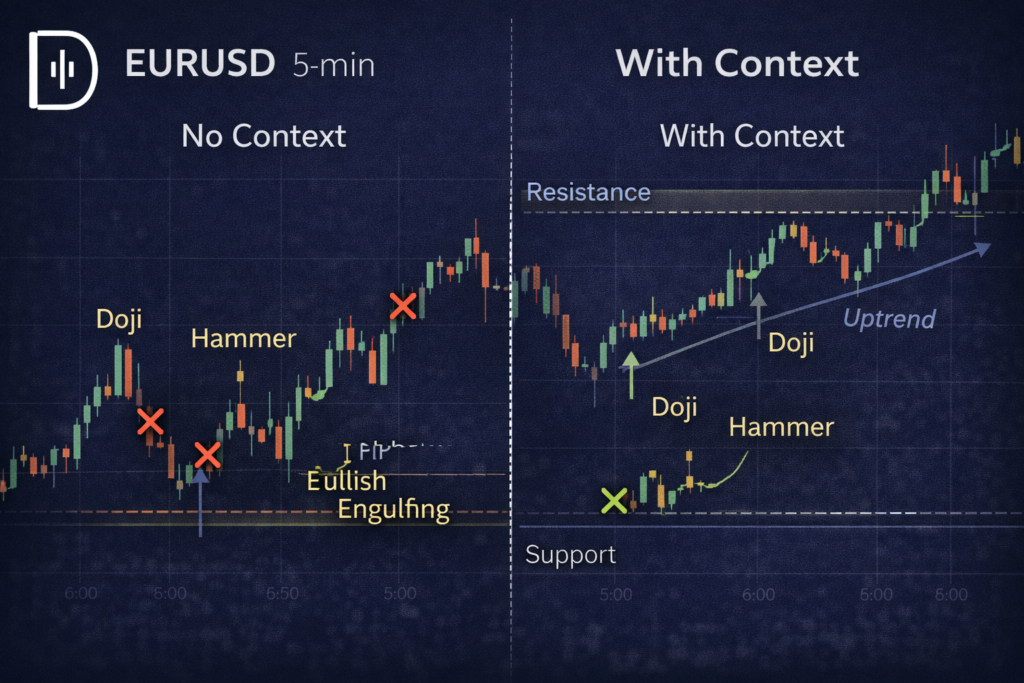
Candlestick patterns are not signals. They are reactions. They show you how buyers and sellers behaved at a specific moment in time.
If you read them in isolation, they feel random. If you read them in context, they become one of the most powerful tools in day trading.
This guide is not about memorizing patterns. It is about understanding what they actually represent and how to use them inside real market conditions.
What Research Says About Candlestick Patterns
Candlestick charting was originally developed by Munehisa Homma, who focused on the psychology behind price movement rather than just price itself.
Modern research has taken a more statistical approach.
Studies referenced by the CFA Institute show that individual candlestick patterns have limited predictive power when used alone.
Educational sites like Investopedia back up the idea that combining pattern reliability with trend direction and support or resistance levels makes it much better.
Data analysis from places like CME Group also shows that order flow and liquidity circumstances are more important than price formations that happen by themselves.
This gives day traders a basic but important insight. Candlestick patterns do not predict the market.
They reveal the battle between buyers and sellers at key locations.
The Shift From Pattern Recognition to Order Flow Reading
Instead of asking “What pattern is this?” start asking “What just happened here?”
Every candlestick tells a story.
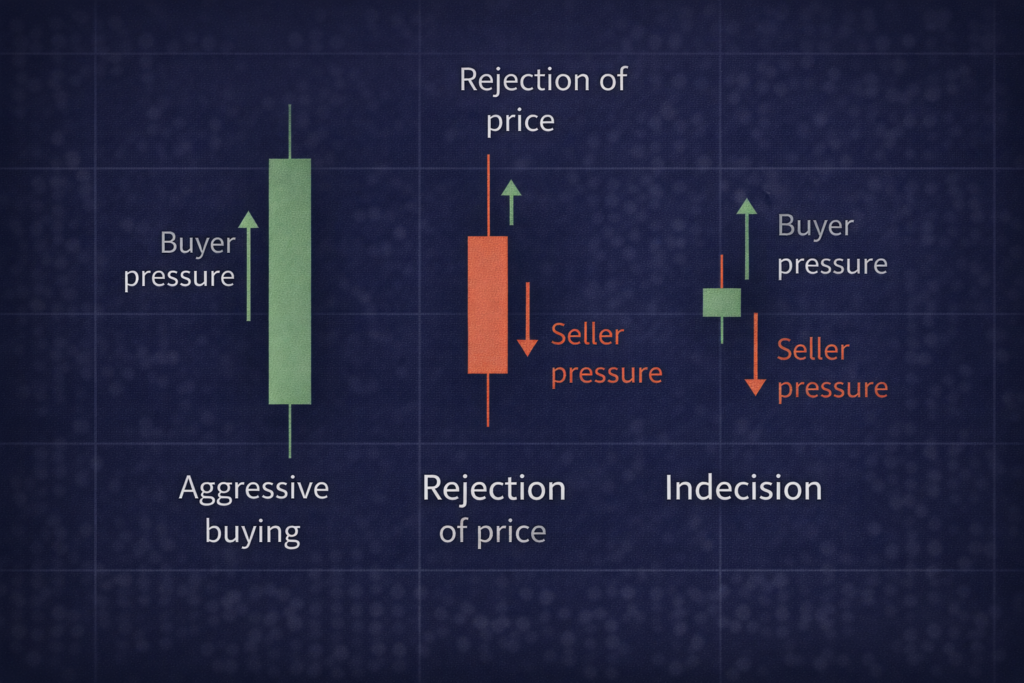
A long bullish candle shows aggressive buying pressure.
A long wick shows rejection of a price level.
A small body with large wicks shows indecision and lack of control.
When you stop focusing on names and start focusing on behavior, candlestick patterns become much easier to interpret.
For example, a bullish engulfing pattern is not just a pattern.
It is a moment where buyers completely absorbed selling pressure and took control.
That is meaningful only if it happens at a level where that shift matters.
The Context Framework for Reading Candlesticks
Candlestick patterns only make sense when placed inside context.
There are three layers you should always consider.
First is market structure.
Is the market trending or ranging? A bullish pattern in an uptrend has a very different meaning than the same pattern in a downtrend.
Second is location.
Is the pattern forming at support, resistance, a breakout level, or in the middle of nowhere?
Third is timing.
Is this happening during a high liquidity session like London or New York, or during a slow market period?
Without these three elements, candlestick patterns lose most of their value.
If you already understand structure, the DayTradersDiary.com article on support and resistance trading pairs directly with candlestick reading.
Patterns do not create edge. Location does.
High Value Candlestick Behaviors That Matter
Instead of memorizing dozens of patterns, focus on a few high value behaviors.
Rejection candles are among the most important. A long wick rejecting a key level shows that one side of the market attempted to push price further but failed.
For example, if price breaks above resistance but forms a candle with a long upper wick and closes back below, it signals failed buying pressure.
Engulfing behavior is another key concept. When one candle completely overtakes the previous candle, it often shows a shift in control.
But again, this only matters at key levels.
Indecision candles such as doji formations are useful when they appear after strong moves. They often signal that momentum is slowing and a potential shift may occur.
The key is not the pattern itself.
The key is what it tells you about participation.
A Practical Trading Framework Using Candlesticks
To make this actionable, let’s walk through a real scenario.
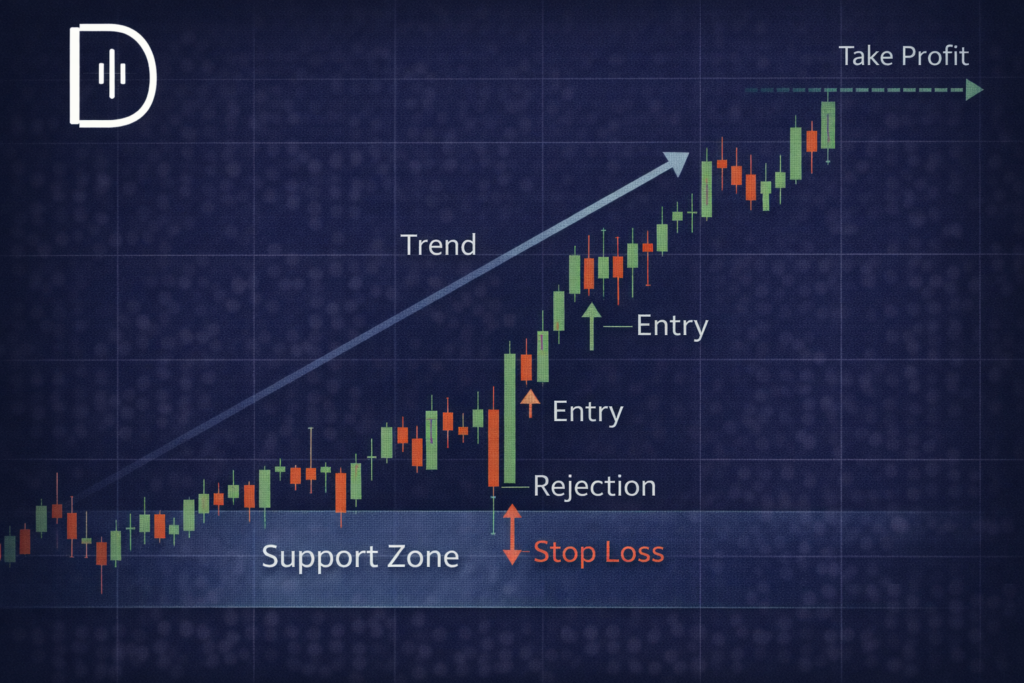
EURUSD is in an uptrend on the higher timeframe.
Price pulls back into a known support level during the London session.
At that level, a rejection candle forms with a long lower wick, followed by a bullish engulfing candle.
This is not just a pattern.
It is a sequence of events.
Sellers attempted to push price lower and failed. Buyers stepped in aggressively and took control.
This creates a high probability continuation setup.
Now flip the scenario.
Price is in a range and approaches resistance during the New York session.
A large bullish candle breaks above resistance, but the next candle forms a long upper wick and closes back inside the range.
This is a failed breakout.
That rejection often leads to a reversal move.
Understanding these sequences is far more valuable than memorizing pattern names.
When Candlestick Patterns Fail
Candlestick patterns fail most often in two situations.
The first is low liquidity.
During quiet market hours, patterns form without meaningful participation. Signals appear clean but lack follow through.
The second is high impact news.
During major economic releases, price can move so quickly that candlestick structures become unreliable.
A perfect pattern can fail instantly when volatility spikes.
This is why timing matters.
If you want to improve your timing, the DayTradersDiary.com guide on trading the London and New York sessions explains when candlestick patterns are most reliable.
Context always overrides pattern.
Risk Management and Execution With Candlesticks
Candlestick patterns are often used for entries, but they are equally important for defining risk.
A rejection candle can provide a logical stop placement.
For example, if you enter a long trade after a bullish rejection at support, the low of that rejection candle becomes a natural invalidation point.
This creates structure based risk rather than arbitrary stop placement.
This is where most traders miscalculate risk. Using a position size calculator removes guesswork and ensures your position size aligns with the actual stop distance.
Candlestick based entries are only effective when paired with disciplined risk control.
Without that, even high probability setups fail over time.
Using Journaling to Improve Pattern Recognition
Most traders look at charts and move on.
They do not track what works.
To improve candlestick reading, you need to document patterns within context.
Record where the pattern formed. Record the session. Record whether the trade aligned with the overall trend.
Over time you will see patterns.
You may discover that rejection candles at key levels perform well during the London session but not during quieter periods.
This type of insight builds real edge.
Using the Trade Journal Template on DayTradersDiary.com helps track these variables and refine your decision making process.
Improvement comes from observation, not memorization.
Scaling a Candlestick Based Strategy
Once you get the hang of candlestick patterns, the next step is to learn how to scale. A good plan that is carried out correctly can bring in constant profits, but the size of your account can make it hard to develop. This is why a lot of traders go into proprietary trading firms. Firms like The5ers, FTMO, and Topstep give traders who are disciplined and consistent access to more money. Candlestick based strategies work well in these environments because they rely on clear structure and repeatable setups.
The5ers in particular focuses on risk controlled growth, which aligns with traders who prioritize precision over frequency.
If your candlestick strategy produces consistent results, testing it within a The5ers evaluation account can be a logical next step.
Professional traders realize edge only matters with capital.
Frequently Asked Questions
Do candlestick patterns work in day trading?
Yes, but only when you apply it in the right context, like trend direction, support and resistance, and session time.
What is the most reliable candlestick pattern?
No single pattern is universally reliable. Patterns become effective when they align with structure and market conditions.
Should beginners memorize candlestick patterns?
Memorizing patterns is less important than understanding what they represent in terms of buying and selling pressure.
Can candlestick patterns predict market direction?
They do not predict direction on their own. They provide clues about market behavior that must be interpreted within context.
Final Thoughts
Candlestick patterns are often misunderstood because traders treat them as signals instead of information.
The market is not giving you instructions.
It is showing you behavior.
If you focus on understanding that behavior, your trading decisions become clearer and more consistent.
For the next two weeks, stop naming patterns.
Instead, describe what you see in simple terms. Who is in control? Who just lost control?
That shift alone can transform how you read price.
If you want to deepen your understanding further, the next article to explore on DayTradersDiary.com is our guide on reading price action without indicators.