
Many day traders discover something frustrating early in their trading journey.
They test a strategy at random times, and the results look inconsistent. One day, the setup produces a strong move. Another day the same setup goes nowhere.
The charts look identical, but the outcome is completely different.
The hidden variable is time.
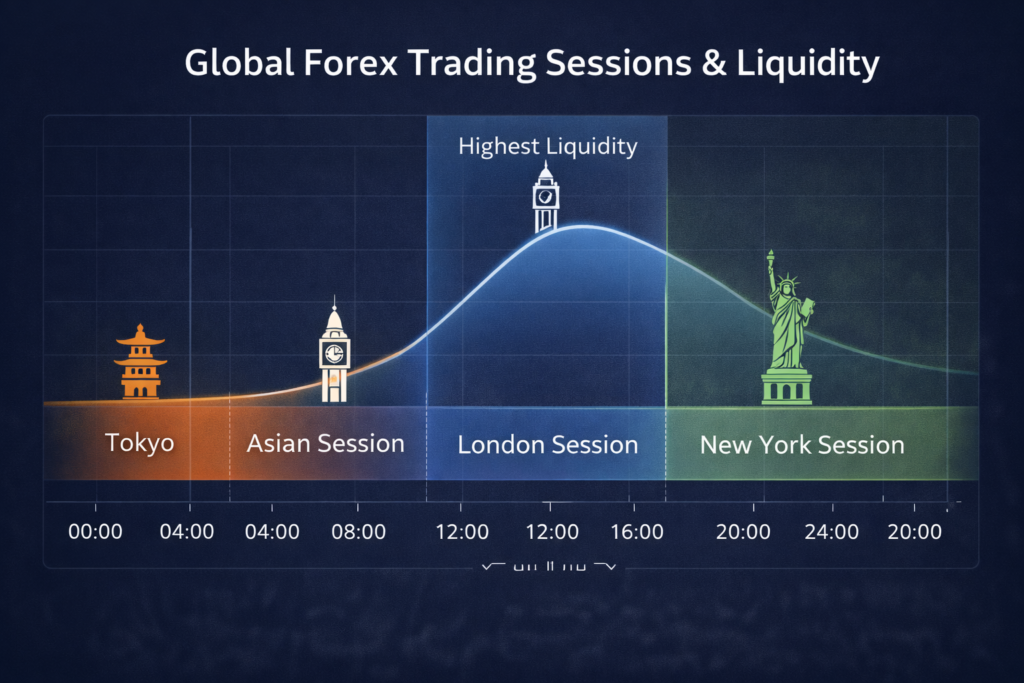
Forex is technically a 24 hour market, but not every hour behaves the same. When the London session begins, liquidity surges, volatility expands, and institutional order flow floods into the market.
For day traders this session often produces the most reliable momentum of the entire trading day.
But it also creates traps. Traders who join too soon, pursue moves too late, or neglect the background set by the Asian session are punished with fast volatility.
It’s not enough to just show up when the London session opens to learn how to trade it. It’s about knowing how liquidity changes, where institutional orders are, and how prices act throughout the first few hours of European participation.
What Research Shows About the London Session
The global foreign exchange market processes more than $7 trillion in daily volume according to the Bank for International Settlements.
However that liquidity is not evenly distributed across the day.
Data discussed by the CME Group shows that activity increases significantly when European financial institutions begin trading.
London is one of the world’s largest financial hubs, and many international banks, hedge funds, and institutional desks operate from this region.
Educational resources such as Investopedia also highlight that volatility increases when multiple global markets overlap.
For day traders this means something simple but powerful.
When the London session opens, the market transitions from relatively quiet Asian trading into a much more dynamic environment. Breakouts occur more frequently, trends form faster, and spreads often tighten as liquidity increases.
Understanding that transition is where the real trading opportunity appears.
Why the London Open Moves Markets
There is less liquidity, fewer people are involved, and currency pairs tend to stay the same unless there is big news from a region.
When London opens, institutional traders look at how they are positioned overnight.
Orders that were waiting during the Asian session are carried out. Large investors move their holdings around. Economic data releases usually happen during European business hours. All of this creates sudden price movement.
For many currency pairs, especially EURUSD and GBPUSD, the first two hours of the London session often determine the day’s directional bias.
This is why experienced traders focus heavily on what happens around this opening period.
If you want to understand how overnight ranges influence these moves, our DayTradersDiary.com article on forex trading hours explains how session transitions shape volatility.
The London Breakout Framework
One of the most common strategies for traders who trade the London session forex market involves the Asian range breakout.
The idea is straightforward.
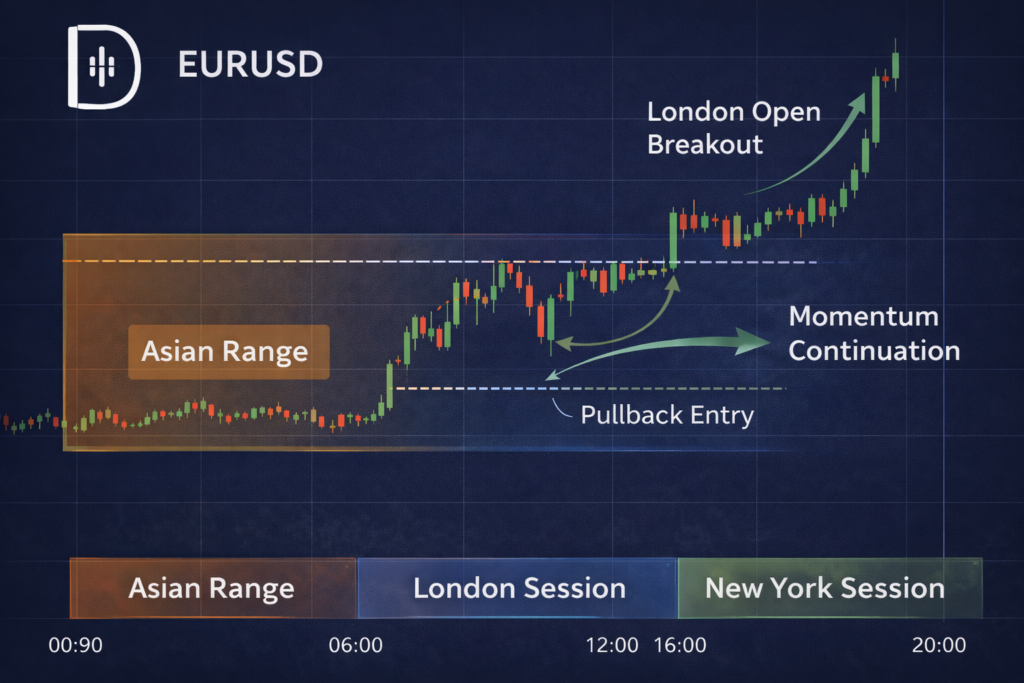
During the Asian session, price frequently trades within a relatively tight range. When London opens and liquidity increases, price often breaks out of that range with strong momentum.
However the edge does not come from blindly trading the breakout.
The real advantage comes from understanding context.
For example, if EURUSD spent the entire Asian session consolidating near a key resistance level and then breaks above it at the London open, that breakout often has strong follow through.
On the other hand, if price already moved aggressively during Asia and London opens directly into major resistance, the breakout may fail.
The difference is positioning.
Professional traders pay attention to where price sits relative to major levels before the session begins.
When London Session Trades Fail
Not every London open produces a trend.
Some days the breakout reverses immediately.
This often happens when traders enter too early.
Many traders attempt to anticipate the breakout before liquidity fully arrives. They enter trades minutes before the London open hoping to catch the move.
But institutional order flow has not yet entered the market.
The result is often a false breakout followed by a sharp reversal once real liquidity arrives.
Another common mistake is chasing the first impulse candle.
Large candles during the opening minutes can feel exciting, but entering at the peak of that move often leads to poor risk to reward positioning.
Professional traders frequently wait for a pullback after the initial volatility surge.
Momentum remains strong, but risk becomes more manageable.
A Practical Routine for Trading the London Session
Day traders who have been doing it for a while don’t usually start looking at markets right when London opens.
Getting ready starts earlier.
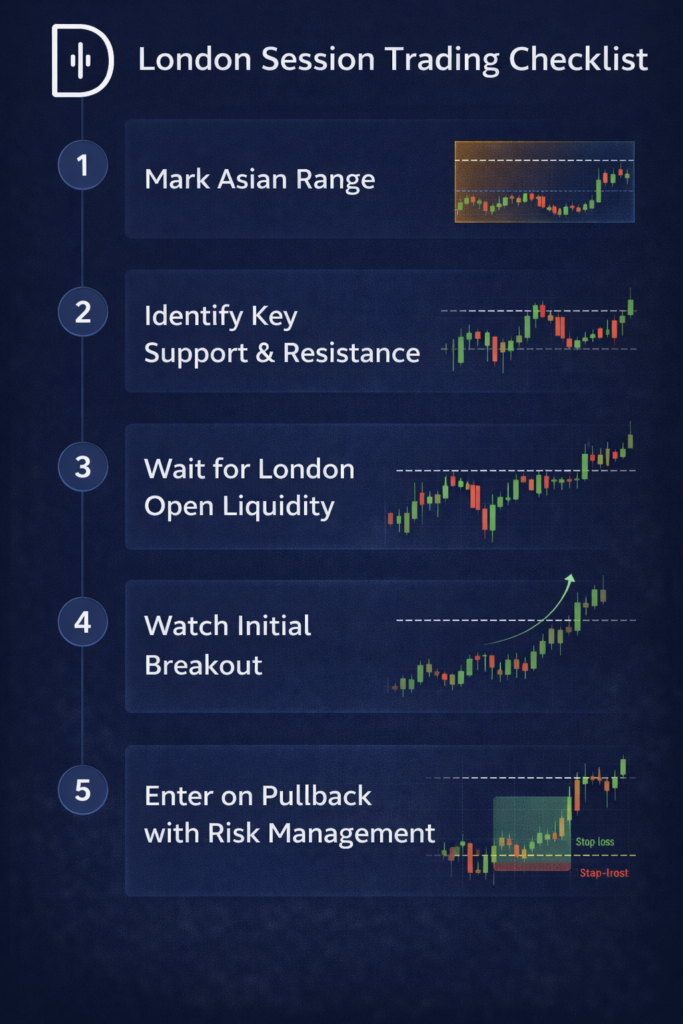
They look over the Asian range and mark the main support and resistance zones before the session starts.
They look at where the price is in relation to certain levels and see if overnight change caused an imbalance.
Instead of immediately placing trades, they watch how the price moves around those levels when the session starts.
The first move in a certain direction frequently shows where institutional liquidity is most concentrated.
This approach helps you be more aware of what’s going on around you and cuts down on emotional trading.
If you want to improve your ability to read these movements, the DayTradersDiary.com guide on identifying high probability breakout setups explains how momentum often builds around session opens.
Risk Management During London Volatility
The London session produces opportunity but also risk.
Volatility expands quickly. Price swings become larger than during the Asian session.
Many traders underestimate how much stop loss distances should adjust during these conditions.
A stop that worked during quiet markets may be far too tight during the London open.
This is where most traders miscalculate risk. Using a position size calculator removes guesswork and ensures that wider stops do not increase overall account exposure.
The goal is not to reduce volatility.
The goal is to structure trades so volatility works in your favor rather than against you.
Execution discipline becomes especially important during these fast moving hours.
Journaling Your London Session Trades
Session based trading improves dramatically when traders track performance based on time of day.
Many traders journal entries and exits but ignore session context.
Your trade journal should record whether the trade occurred during the Asian session, London session, or New York session.
Over time this reveals powerful insights.
Some traders discover that their strategies perform exceptionally well during the London open but poorly during quieter hours.
Others find that waiting for the London New York overlap produces the best conditions.
Using the Trade Journal Template available on DayTradersDiary.com allows traders to track session specific performance and refine their trading schedule.
Often the fastest improvement comes from eliminating trades during weak market conditions.
Scaling a London Session Strategy
Once traders learn to trade London session forex setups consistently, another challenge appears.
Capital limitations.
A strategy that generates consistent returns may still produce modest absolute profits if account size remains small.
This is why many disciplined traders explore proprietary trading evaluation programs.
Firms like The5ers, FTMO, and Topstep allow traders to demonstrate risk discipline in exchange for access to larger capital allocations.
Session-based trading techniques frequently work well in these situations since they depend on set routines and clear volatility windows.
The5ers in particular stresses progressive scaling and regulated risk models that work well for traders who want to execute trades consistently every day.
If your London session strategy produces stable results, testing it through a The5ers evaluation account can be a logical step toward expanding your trading capacity.
Professional traders eventually realize that consistency plus capital creates the real growth curve.
Frequently Asked Questions
What time does the London forex session start?
The London session usually starts around 8:00 AM London time, although traders often get ready for the open a little earlier, which makes things busier.
Why is the London session important for forex traders?
It introduces significant liquidity and institutional participation, often creating strong price movement and clearer trading opportunities.
Which currency pairs move most during the London session?
Pairs involving the euro and British pound, such as EURUSD and GBPUSD, often show the strongest activity during this session.
Is the London session good for scalping?
Yes. High liquidity and volatility make it one of the most popular sessions for scalpers and momentum traders.
Final Thoughts
The London session is where the forex market often comes alive.
Liquidity increases, institutional participation rises, and price movement becomes meaningful rather than random.
But success during this session rarely comes from reacting quickly.
It comes from preparation.
For the next month, focus on one habit. Before the London open, map the Asian range and mark the key levels where price might break or reverse.
Then observe how the market behaves when Europe enters the picture.
That small routine can transform the way you trade the most active hours of the forex market.
If you want to build a complete session based strategy, the next article worth reading on DayTradersDiary.com is our guide on trading the New York session for momentum opportunities.