
The first few minutes after a geopolitical shock are chaotic.
News breaks about a military strike or a sudden escalation between countries. Equity futures drop instantly. Volatility spikes. Liquidity disappears from certain markets while other assets suddenly move with explosive momentum.
Most retail traders react too late.
They chase moves that are already extended or freeze because the market no longer behaves according to their normal setups. Meanwhile professional traders are already looking somewhere else.
They are watching the assets that historically move the fastest when war begins.
Understanding which assets rise during war is not about predicting conflicts. It is about recognizing how capital flows react when global risk suddenly changes.
This article explains the assets that tend to explode during geopolitical crises and how active traders can turn that knowledge into a structured trading framework rather than emotional reaction.
What Research Says About Markets During War
Financial history shows a consistent pattern during geopolitical crises. Investors quickly rotate capital toward assets linked to security, energy supply, and safe value storage.
Research from the Bank for International Settlements shows that during periods of geopolitical stress global capital flows shift rapidly across asset classes. Safe stores of value and strategic commodities typically experience the largest inflows.
The International Monetary Fund has also documented that commodity markets, particularly energy and precious metals, tend to react strongly during military conflicts that threaten supply chains.
Meanwhile studies referenced by the World Gold Council show that gold historically attracts institutional demand during periods of uncertainty and geopolitical instability.
For day traders, this research confirms a simple but powerful reality.
When war begins, money moves quickly into specific asset classes. Understanding those flows can provide directional bias long before technical indicators adjust.
Why Certain Assets Explode When War Starts
Markets react to war through two main mechanisms.
The first is fear driven capital flight. Investors move money into assets perceived as stable stores of value.
The second is supply shock risk. Military conflicts often threaten production or transportation of critical resources.
Assets linked to these dynamics tend to move aggressively.
The key is recognizing which category an asset belongs to.
Some assets rise because investors seek safety. Others rise because the conflict disrupts supply chains.
Knowing the difference helps traders anticipate which markets may produce the strongest moves.
Gold and the Psychology of Financial Safety
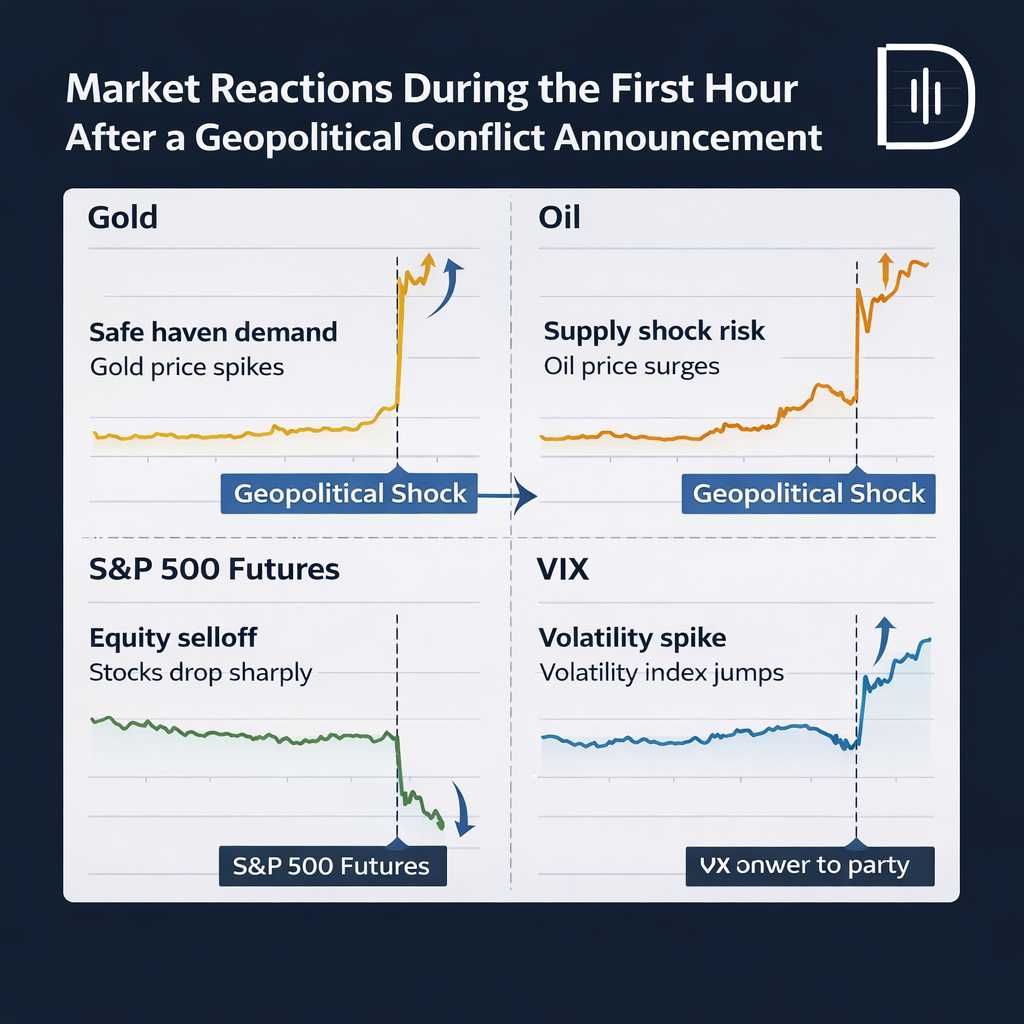
Among all assets that rise during war, gold remains the most widely recognized.
Gold has served as a store of value for centuries, long before modern financial markets existed. During geopolitical crises institutions often increase exposure to precious metals as a hedge against currency instability and financial uncertainty.
For traders this creates powerful momentum opportunities.
Gold often reacts extremely quickly to geopolitical headlines. Sharp upward moves frequently occur within minutes of major announcements.
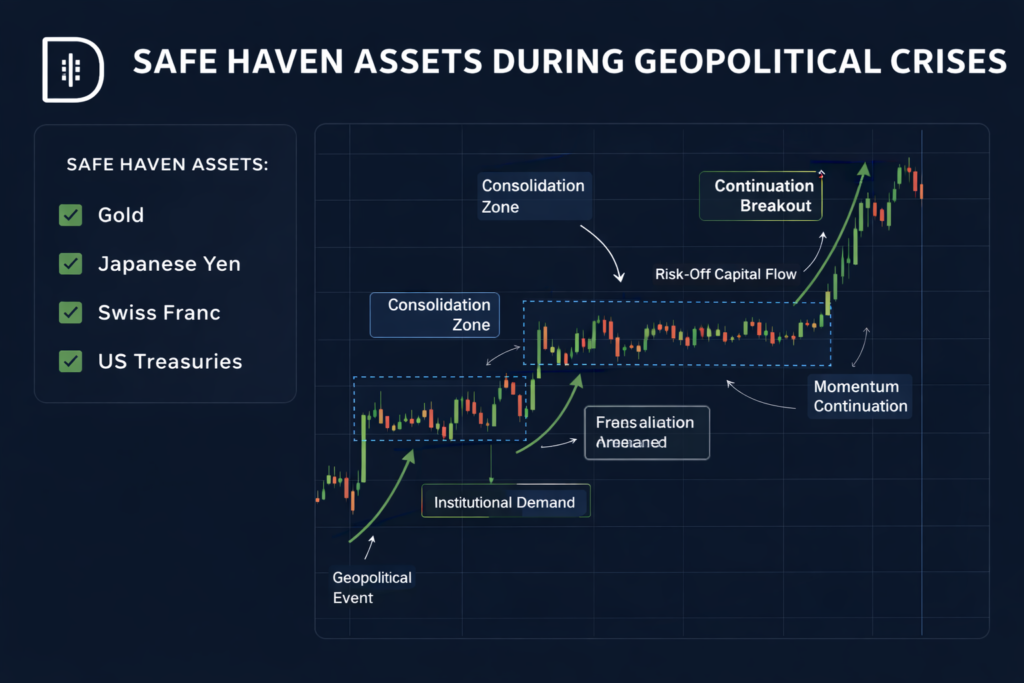
However the most reliable opportunities rarely occur during the first spike.
Professional traders often wait for the initial volatility surge to stabilize before trading continuation setups.
For example, after a major geopolitical headline gold may spike $20 to $30 in minutes. Once the initial wave of buying pauses, a consolidation often forms before the next directional leg.
If you already trade gold actively, you may recognize this pattern. It reflects institutional accumulation rather than random volatility.
Our DayTradersDiary.com guide on trading gold volatility explores these continuation patterns in greater detail.
Oil and the Supply Shock Effect
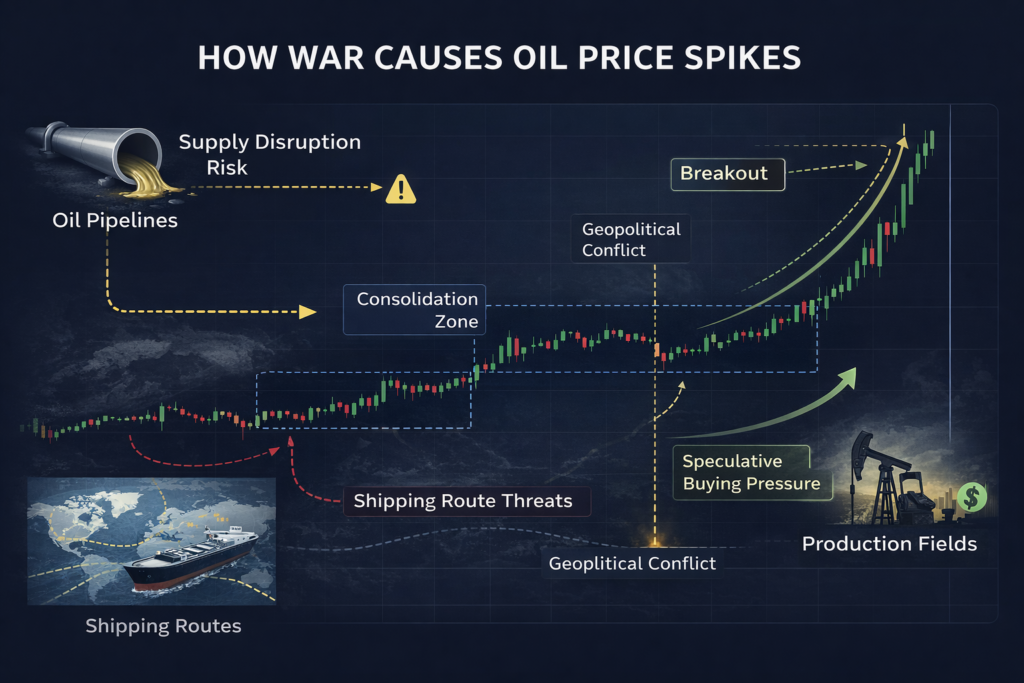
While gold reacts to fear, oil reacts to supply risk.
Military conflicts frequently occur in regions that produce or transport energy. When war threatens pipelines, shipping routes, or production facilities, oil prices can surge rapidly.
This dynamic has repeated across decades of geopolitical history.
Oil traders pay close attention to conflicts in the Middle East, Eastern Europe, and other strategic energy regions.
Even the possibility of supply disruption can trigger speculative buying.
From a day trading perspective, oil markets often produce some of the most explosive intraday moves during geopolitical crises.
But there is a catch.
Oil also experiences violent reversals when supply fears fade. Headlines confirming stable production can quickly erase earlier price spikes.
This makes risk management essential when trading war driven oil volatility.
Defensive Currencies and Global Capital Flow
Currencies also play an important role during geopolitical shocks.
Certain currencies historically strengthen when global risk rises. The most well known examples are the Japanese yen and Swiss franc.
These currencies tend to attract capital during uncertain periods because their economies are viewed as relatively stable and their financial systems conservative.
During war driven market stress traders often see rapid appreciation in these currencies against risk sensitive counterparts.
For example, currency pairs involving the yen may move sharply when equity markets fall and safe haven demand rises.
Understanding these correlations can help traders avoid fighting the dominant macro flow.
If you want to strengthen this perspective, our article on intermarket analysis on DayTradersDiary.com explains how currencies, commodities, and equities interact during global risk shifts.
A Practical Framework for Trading War Driven Markets
When geopolitical tensions escalate, experienced traders follow a structured process.
First they identify whether the event has real economic implications. Not every conflict triggers large market reactions.
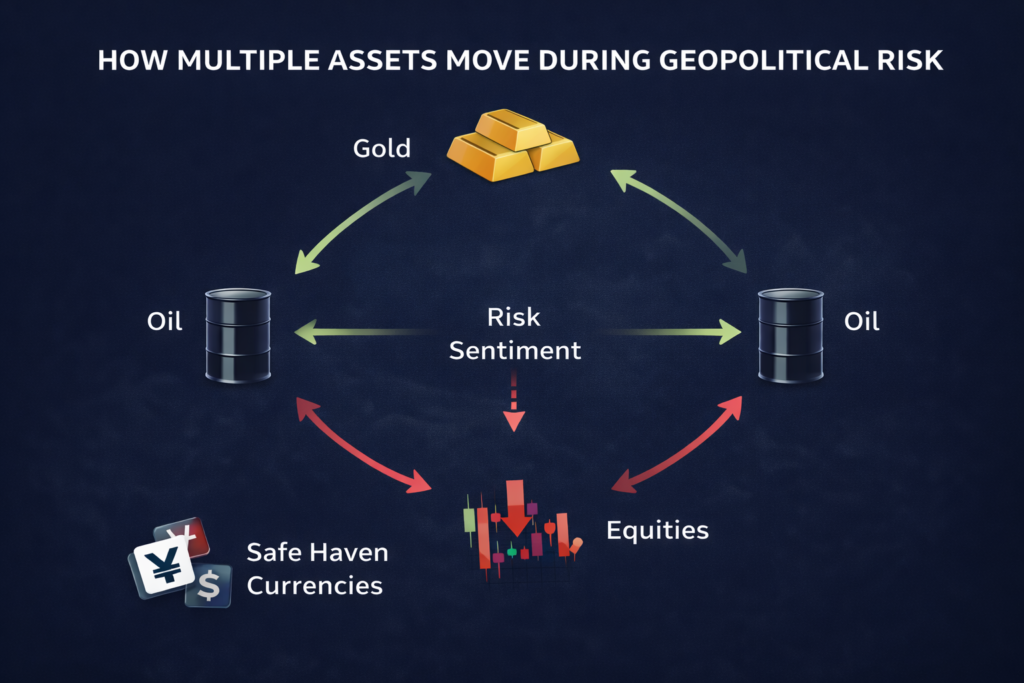
Second they observe cross market confirmation. When gold rises, oil surges, and equity futures fall simultaneously, the market is clearly shifting into a risk off environment.
Third they focus on momentum rather than mean reversion. Panic driven flows often produce strong trends that persist longer than expected.
A typical example might look like this.
Gold breaks above a major resistance level after geopolitical headlines. Oil simultaneously rallies due to supply concerns. Equity indices decline as risk appetite fades.
Rather than attempting to catch reversals, traders may look for pullback entries in the direction of the dominant macro move.
Momentum often remains strong while the geopolitical narrative continues.
Risk Management During Geopolitical Volatility
War driven volatility can create large opportunities but also significant risk.
Spreads widen. Liquidity fluctuates. Price swings expand dramatically.
Many traders make the mistake of maintaining normal position size during these periods.
That approach can quickly damage an account.
Volatility requires adjusting exposure.
This is where most traders miscalculate risk. Using a position size calculator removes guesswork and ensures that larger stop losses do not accidentally increase account exposure.
Even experienced traders often reduce size during geopolitical uncertainty. Smaller positions allow them to stay flexible while still participating in the move.
Protecting capital is always the priority.
Journaling Geopolitical Market Behavior
Geopolitical trading gets a lot better when traders keep track on how markets react to big occurrences.
Most journals keep account of admissions and exits, but they don’t look at the bigger picture.
A few extra observations can lead to significant new ideas.
Keep track of if gold, oil, or safe haven currencies changed a lot during the trade. Keep track of whether the stock markets were going up or down at the same moment. Over time patterns appear.
Some strategies perform best during calm conditions. Others thrive when volatility explodes.
Using the Trade Journal Template available on DayTradersDiary.com helps organize these observations and refine your trading process.
Markets are driven by behavior. Journaling helps decode that behavior.
Scaling War Driven Strategies With Larger Capital
Once a trader develops consistent execution during volatile environments, capital size becomes the next limitation.
Even strong trading performance can feel slow when applied to a small account.
This is why many professional traders explore evaluation programs offered by proprietary trading firms.
Companies like The5ers, FTMO, and Topstep provide structured opportunities for traders to access larger capital after demonstrating discipline and consistency.
Strategies based on geopolitical momentum often scale well because these events create strong directional moves across multiple asset classes.
The5ers in particular emphasizes gradual capital growth and strict risk management, which aligns well with traders who rely on structured macro frameworks.
If your strategy already handles volatility and risk effectively, exploring a The5ers evaluation account may be a logical step toward expanding your trading capacity.
Professional traders eventually realize that skill alone is not enough. Capital efficiency matters too.
Frequently Asked Questions
Which assets usually rise during war?
Gold, oil, the Japanese yen, and the Swiss franc are among the most common assets that rise during geopolitical conflict due to safe haven demand or supply concerns.
Why does oil spike during military conflicts?
Oil prices often rise because conflicts can threaten production facilities, pipelines, or shipping routes that transport energy supplies.
Does gold always rise during war?
Gold frequently benefits from geopolitical uncertainty, but the magnitude of the move depends on how severe the conflict is and whether it threatens global economic stability.
Are war driven market moves predictable?
The exact size is hard to anticipate, but historical patterns demonstrate that some types of assets always respond to geopolitical risk.
Final Thoughts
Markets act differently during war.
Liquidity moves faster, volatility grows, and money goes toward assets that are tied to safety or strategic resources.
Traders who know how these things work have a big edge.The next time geopolitical tensions escalate, watch how gold, oil, currencies, and equities respond together.
If you want to deepen your understanding of macro driven market moves, the next article to explore on DayTradersDiary.com is our guide on how global news events reshape intraday trading opportunities.