
Most traders lose money with RSI for one simple reason. They treat it like a signal, not a context tool.
You have seen it before. RSI hits 70, you short. It hits 30, you buy. Price keeps trending, and you get steamrolled. After a few losses, you conclude RSI does not work for day trading forex.
The truth is different. RSI is not designed to call tops and bottoms. It is designed to measure momentum shifts relative to recent price behavior. If you use it mechanically, it will punish you. If you use it conditionally, it becomes one of the most powerful day trading tools available.
This guide is not about textbook definitions. It is about how active intraday traders can extract edge from RSI, choose the best RSI period for day trading, and avoid the common traps that quietly destroy expectancy.
What the Research Actually Says About RSI
Before we get practical, let’s ground this in evidence.
The Relative Strength Index was introduced by J. Welles Wilder Jr. in his book New Concepts in Technical Trading Systems. Wilder originally used a 14-period setting and applied it across commodities markets.
According to research summaries published by CMT Association, RSI works best when used in conjunction with trend filters rather than as a standalone overbought or oversold trigger. Academic reviews of technical indicators often show that oscillators don’t work well on their own, but they can make rule-based systems better when the conditions of the regime are clear.
How does this affect real day traders?
It means that RSI can’t tell you what’s going to happen on its own. It depends on something. It works differently in trending markets than it does in range-bound sessions. If you do not classify market structure first, your RSI signals are random.
Most Google results stop at “RSI above 70 is overbought.” That is beginner logic. Professional intraday traders think in terms of environment first, signal second.
RSI Day Trading Forex: The Core Misconception
In forex, especially pairs like EURUSD or GBPUSD during the overlap of London and New York, momentum can last for hours.
If you short every RSI 70 reading in a strong trend, you are going against the trend. That’s not the edge. That’s ego.
The right question isn’t “Is RSI overbought?”
The right question is: Is RSI showing that momentum is running out compared to structure?
There is a difference.
Overbought in a breakout is strength.
Overbought at higher time frame resistance after a parabolic move is potential exhaustion.
Your job is to separate the two.
Best RSI Period for Day Trading
The default 14-period RSI is not sacred. It is a compromise between sensitivity and smoothing.
Here is how experienced day traders think about it:
A 14-period RSI is often too slow for scalping on 1-minute and 3-minute charts. A lot of intraday traders try out 7 or 9 periods to get feedback faster. More noise is the trade-off.
14 is still strong on 5-minute and 15-minute charts. It gets rid of small changes but still picks up changes during the day.
On 1-hour charts that show the direction of the market, 14 or even 21 can help you find bigger momentum zones.
There is no one-size-fits-all answer to what the best RSI period is for day trading. It depends on how long you hold and how volatile the market is. When there is a lot of news, shorter RSI settings can get out of hand. A shorter RSI may give earlier signals in slower Asian sessions.
Being consistent is the most significant thing. Pick a setting, try it out with your specific pair and session, and then keep track of how well it works. Don’t change your settings every week based on how things went the week before.If you want to know more about how to execute trades, you should read our article again about market orders and limit orders. If you don’t do it right, RSI signals don’t mean anything.
The Professional RSI Framework for Day Traders
Let me give you a practical decision model that works in live markets.
Step one is regime classification.
Is price trending or ranging?
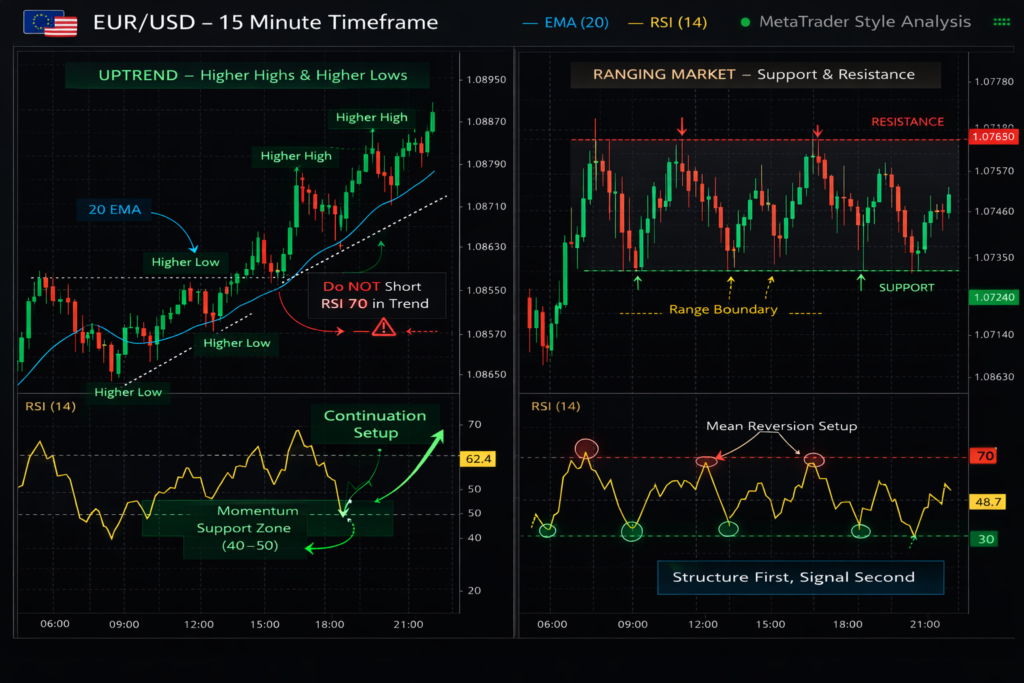
You can define trend simply using higher highs and higher lows on the 15-minute chart, or by aligning with a 20 or 50 EMA slope. In a trend, RSI behaves differently. In a range, it behaves predictably.
In a trending market, ignore overbought and oversold levels as reversal signals. Instead, look for RSI pullbacks into the 40 to 50 zone in an uptrend and 50 to 60 in a downtrend. That zone often acts as momentum support or resistance.
Example scenario. EURUSD is in a clear uptrend during London session. Price pulls back to intraday support. RSI drops from 75 to 45 without breaking below 40. That compression often signals a continuation opportunity, not a reversal.
In a ranging market, classical 30 and 70 levels become useful again. But only when price is near range boundaries. RSI oversold in the middle of a range is meaningless.
This structure-first approach alone filters out a large percentage of losing trades.
RSI Divergence: Use With Precision, Not Hope
RSI divergence is widely misunderstood.
When the price makes a lower low but the RSI makes a higher low, this is called bullish divergence. Bearish divergence is the other way around. The problem is timing. Divergence can persist for long periods before price reverses. In strong trends, it often fails completely.
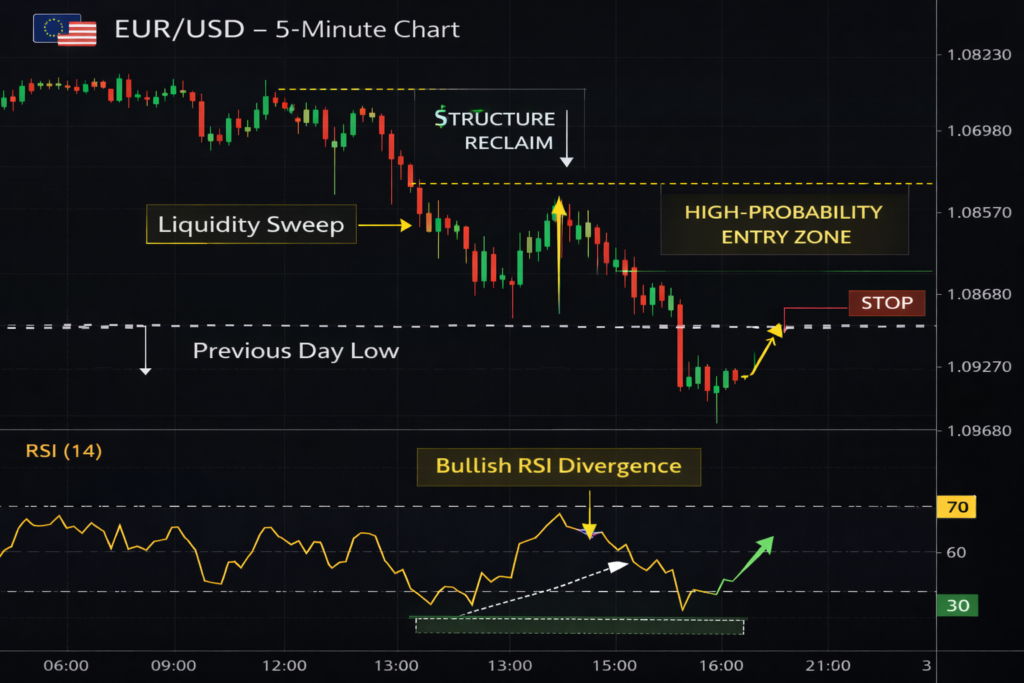
The only time divergence has statistical relevance intraday is when it aligns with higher time frame liquidity zones. For example, price sweeps a prior day low, prints bullish divergence on the 5-minute chart, and immediately reclaims structure.
That is not just divergence. That is liquidity plus momentum shift.
If you trade divergence without thinking, your journal will show results that don’t make sense. Expectancy is better when divergence and structural context are put together.
Combining RSI With Volatility and Structure
RSI without volatility context is incomplete.
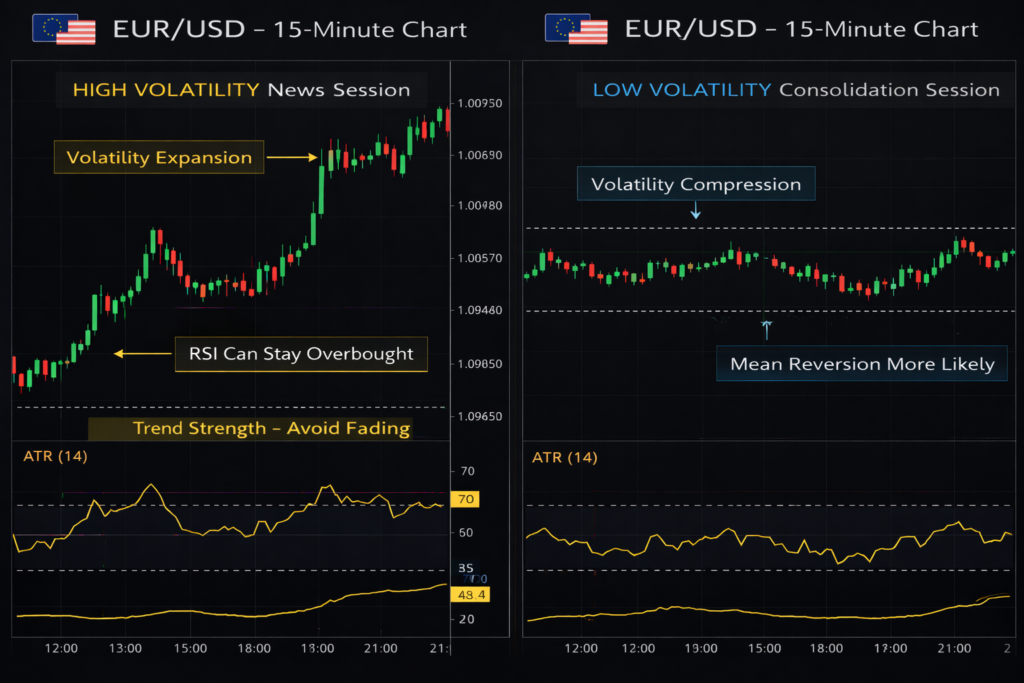
This is where tools like ATR come into play. If volatility is expanding, RSI extremes can stretch further than expected. If volatility is going down, mean reversion setups are more likely to work.
For instance, during a news release with a lot of volatility, the RSI can stay above 70 for a long time. It is very unlikely that that strength will fade. On the other hand, during low volatility consolidation, RSI extremes tend to go back to normal quickly.
When you add structure, volatility, and RSI together, you go from trading based on indicators to trading based on decisions.
Risk and Execution: Where Most RSI Traders Fail
Even a solid RSI framework collapses without risk discipline.
Many traders size up because an RSI signal “looks strong.” That is emotional sizing. It leads to inconsistent drawdowns.
This is where most traders miscalculate risk. Using a position size calculator removes guesswork. It ensures that each RSI setup carries predefined risk based on account percentage, stop distance, and pair volatility.
If you are trading intraday pullbacks using RSI 40 as support, your stop placement must be structural, not indicator-based. RSI crossing below 40 is not a stop. Structure breaking is a stop.
Execution matters too. If spreads widen during volatile sessions, your entry quality deteriorates. Review your fill quality in your trading log. Small inefficiencies compound over time.
Journaling RSI Trades the Right Way
Most traders journal outcomes. Professionals journal context.
Instead of writing “RSI oversold, went long,” your journal should capture:
Market regime
Session timing
Higher time frame bias
Volatility state
Reason for entry
Reason for exit
Use a structured Trade Journal Template so you can review patterns objectively. After 50 trades, you should know whether your RSI day trading forex setups work better in London open or New York continuation.
Performance optimization is about pattern recognition. If 70 percent of your losses come from counter-trend RSI trades, the solution is obvious. Stop fading strength.
Scaling the Edge: Capital Constraints
Let’s assume you refine your RSI framework. You risk 0.5 to 1 percent per trade. You achieve consistency.
Now you hit the ceiling of account size.
This is where serious traders look at evaluation programs like The5ers. The logic is simple. If you have edge and discipline, scaling capital responsibly accelerates growth.
Evaluation accounts force risk discipline through defined rules. That structure actually improves many traders’ performance. Firms like FTMO and TradeThePool offer alternative models with different drawdown and scaling rules.
This is the most important point. Edge without capital limits the upside. Accounts are ruined by capital without edge. The professional path is to do both.
If you are consistently making money with a tested RSI framework, you might want to apply for a The5ers evaluation account as a way to grow your business in a responsible way.
Common RSI Day Trading Mistakes
The biggest mistake is using RSI mechanically without market context.
The second mistake is constantly changing RSI periods to fit recent losses.
The third mistake is overtrading every signal during low-quality sessions.
RSI should reduce trades, not increase them. If you are taking more trades because of RSI, you are likely misusing it.
Frequently Asked Questions
What is the best RSI time frame for day trading forex?
For most intraday traders who use 5-minute or 15-minute charts, 14 periods still works well. Settings that are shorter, like 7 or 9, make things more sensitive but also make more noise. The best setting is the one you test and use all the time.
Is RSI good for short-term trading?
Yes, but only if it fits with the structure and the volatility. When looking at very short time frames, RSI needs to be used with clear liquidity zones and tight execution control.
Does RSI work in trending markets?
Yes, but not as a reversal tool. In trends, RSI pullbacks to the 40 to 50 zone often provide continuation entries rather than fade setups.
Should I use RSI alone?
No. RSI measures momentum. It does not define structure, liquidity, or volatility. Combine it with price action and session awareness.
Final Takeaway
RSI is not a sign of magic. It is a lens for acceleration.
This week’s challenge is easy. Don’t trade every time the RSI hits 70 or 30. Only take RSI setups that fit with the higher time frame structure and the defined regime conditions for the next 20 trades.
Then look over your journal.
You will either prove your edge or show that you are not consistent. If you want to get even better at executing, the next thing you should read is our guide on market orders vs. limit orders. Even the best RSI strategy won’t work if you don’t stick to it.