
A lot of day traders don’t know how to use volume.
They look at the histogram at the bottom of the chart, see a spike, and think it backs up the move. Then the price goes back down quickly, and they are left wondering why “high volume” didn’t work for them.
Volume doesn’t tell you which way the market is moving. It proves that you are taking part.
That difference makes a big difference.If you want the best volume indicator for day trading, you need to stop asking which tool is strongest and start asking what type of participation you are measuring. Aggressive market orders. Passive absorption. Exhaustion. Breakout commitment.
This guide is built from screen time, trade logs, and years of watching how volume behaves during fake breakouts, news spikes, and session opens. We will go deeper than the standard textbook explanation of On Balance Volume or Volume Weighted Average Price.
You already know what volume is. Let’s talk about how actually to use it for edge.
What Research Tells Us About Volume and Intraday Behavior
Volume is not just a retail concept. It is central to market microstructure research.
Studies often cited by the CFA Institute show a strong relationship between volume surges and short-term increases in volatility. For day traders, this explains why breakouts with rising volume tend to extend farther than those with low volume.
The Bank for International Settlements has shown that liquidity in FX markets tends to be highest during major session overlaps and macro updates. That means that the way volume acts changes when the London market opens compared to when the Asian session drifts.The National Bureau of Economic Research often publishes academic work that talks about the connection between an imbalance in order flow and short-term momentum persistence. For traders, this means that when aggressive buyers or sellers are in charge, prices are more likely to keep going up or down, but only for a short time.
This is what matters.
Volume increases don’t always mean the market is going up or down. They represent effort. Your job is to judge whether that effort results in progress.
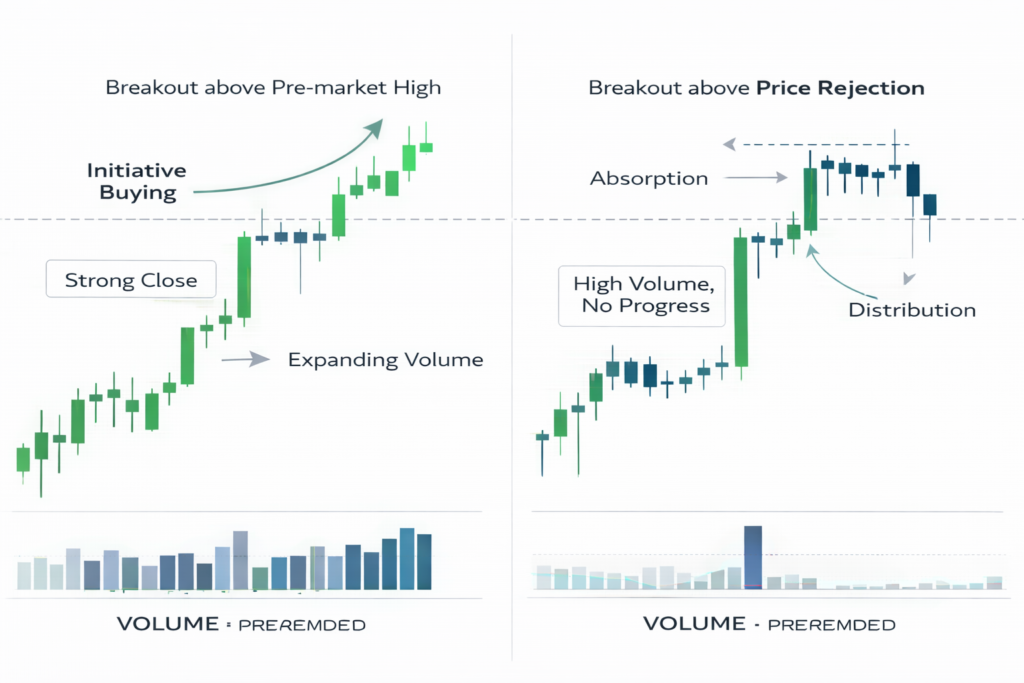
High volume with no price progress often signals absorption or exhaustion. Moderate volume with clean directional candles during session opens often signals initiative participation.
The best volume indicator for scalping or day trading is the one that helps you identify effort versus result in real time.
Core Volume Indicators That Actually Add Edge
There are dozens of volume tools available. Most are redundant.
Let’s focus on the ones that provide distinct information rather than cosmetic variation.
Volume Histogram
This is the simplest and still one of the most useful tools. But only if you use it comparatively.
Do not ask whether current volume is high. Ask whether it is high relative to the previous 20 bars at this time of day. A spike during New York open means something different than the same spike at lunch hours.
For breakout traders, expanding histogram bars during range compression often precede volatility expansion. If you are trading breakout strategies, combine this with our guide on building a structured intraday breakout plan on DayTradersDiary.com to refine timing.
Volume Weighted Average Price
VWAP is not just a line. It represents the average price weighted by volume for the session.
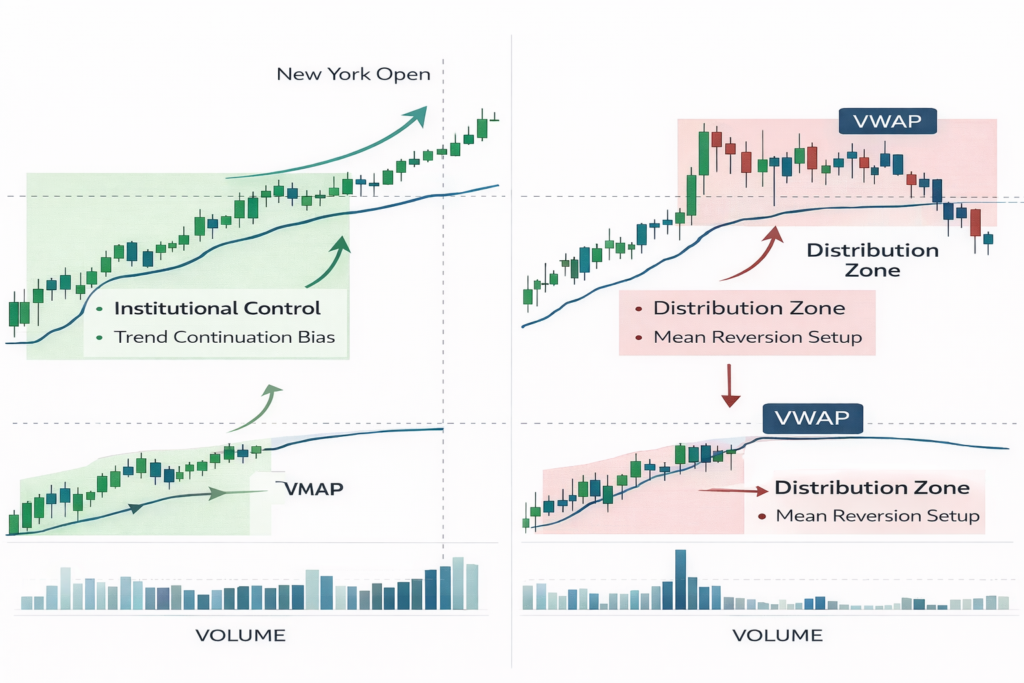
Institutions often benchmark execution against VWAP. When price trades significantly above VWAP with sustained volume, buyers are in control on an intraday basis. When price repeatedly fails to hold above VWAP despite high volume, distribution may be underway.
For scalpers, VWAP offers dynamic mean reversion zones. For trend day traders, it acts as a continuation filter.
On Balance Volume
People often say that OBV is outdated, but it can show hidden divergence.
If the price makes a higher high but the OBV doesn’t confirm it, participation may be going down. This is particularly beneficial for swing trading situations where you are looking at continuation over several days.
Profile of Volume
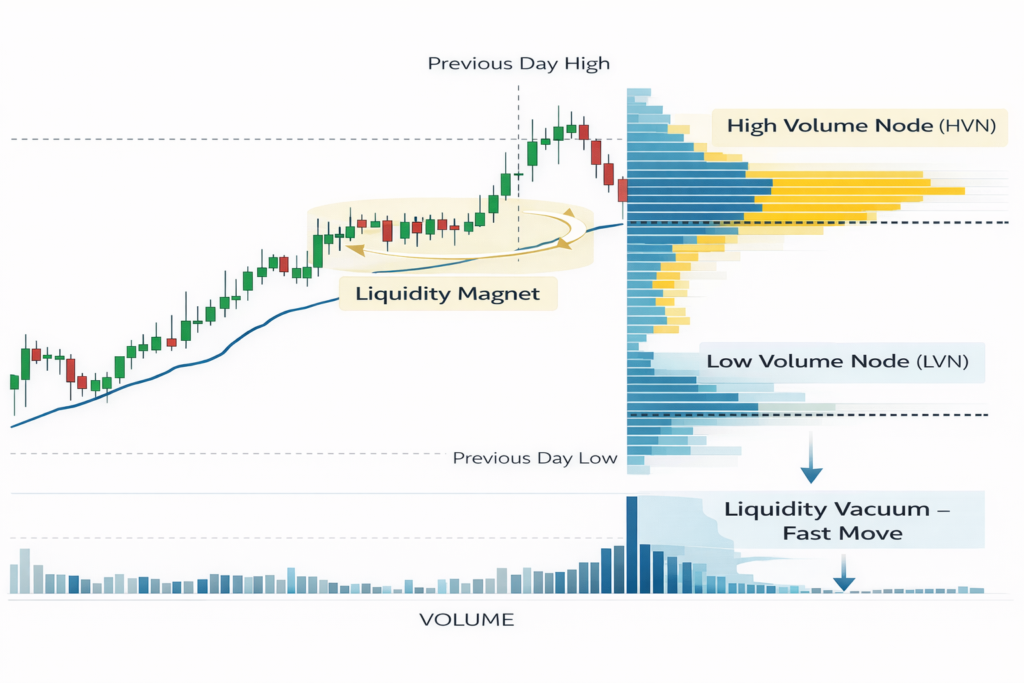
This is when things start to get more difficult.Volume profile shows where trading has been focused at certain price levels, not just over time. High-volume nodes are often like magnets or areas of support and resistance. Low volume areas show that people don’t want to buy or sell, and prices tend to move faster when they are visited again.
For day trading, combining volume profile with intraday structure helps you identify whether a breakout is entering a high liquidity area or breaking into a vacuum.
The best volume indicator for swing trading is often volume profile combined with daily structure, not a simple histogram.
A Practical Framework for Using Volume in Real Time
Instead of adding five indicators, make your decision-making process easier.
The first question. Is the volume going up or down compared to recent bars and session norms?
The second question. Is the price going up in proportion to the volume?
Third question. Where is this happening in the structure of the higher time frame?
Let me give you an example.
At the New York open, prices on a stock index future break above the pre-market high. The volume goes up a lot more than the average for the last 30 minutes. Candles close near their highs with very short upper wicks. That’s what initiative buying is. The odds are in favour of continuation.
Now think about the same breakout that had a lot of volume but long upper wicks and didn’t close above the level. That means absorption. Someone is selling into strength.
Same sign. Another way to think about it.
Volume doesn’t tell you what’s going to happen. It puts things in context.
When Volume Indicators Fail
Volume tools underperform in algorithm-driven chop and during low liquidity sessions.
In Forex, tick-based volume data is used instead of centralised exchange volume data. It still has a strong connection to activity, but it’s not perfect.
Volume divergence on its own is also not reliable. A lot of traders short strong trends just because OBV is going in the opposite direction. Trends can last much longer than divergence suggests.
Volume should not change structure; it should confirm it.If you are not aligning volume signals with clear market structure and risk to reward logic, you are using it as decoration.
Risk Management and Execution with Volume-Based Setups
Volume spikes create emotional urgency.
Traders oversize positions because moves feel explosive.
This is where most traders miscalculate risk. Using a position size calculator removes guesswork and forces you to adjust lot size according to stop distance, especially during high volatility expansions.
When volume expands, spreads can widen and slippage increases. Your stop placement must account for this. If your backtested stop is 5 points but live slippage during news averages 2 points, your real risk per trade is larger than expected.
Before you make any high-volume breakout trades, read our guide on how to manage risk and use the Position Size Calculator. When the market is volatile, consistency keeps your money safe.
Journaling Volume-Based Trades
Most traders keep track of when they enter and exit. Very few people log their participation context.
If you want to improve the best volume indicator for day trading in your own way, keep track of:
Session
Volume relative to session average
Price progress versus volume
Outcome in R
Over 50 trades, patterns will emerge. You may discover that high-volume breakouts during London session perform well, while low-volume mean reversion trades during New York lunch underperform.
Our Trade Journal Template helps you tag these contextual variables. Without structured journaling, you will attribute wins to skill and losses to randomness.
Volume trading becomes powerful only when combined with data about your own behavior.
Scaling a Volume-Based Edge
Once you find setups that work consistently with volume confirmation, money becomes the limiting factor.A trader who consistently makes 1% to 2% a month on a small account has built something useful. But it can take a long time to scale that up with just your own money.
This is when evaluation models stop being guesses and start being strategic.
Firms like The5ers, FTMO, and Topstep give you structured access to capital with clear rules for when you can draw down.
The5ers‘ scaling plan model makes it a good fit for disciplined day traders. As you show that you can stick to your risk limits, your capital allocation goes up.
A volume-based strategy that stays within strict risk limits can be made bigger. One that depends on oversized bets during spikes will not pass evaluation constraints.
If you’ve already tested your edge with backtesting and forward journaling, you might want to try it out in a The5ers evaluation account. See it as a professional goal, not a chance to win money.
Frequently Asked Questions
What is the best way to measure volume for day trading?
There is no one best thing. The volume histogram and VWAP together give a lot of information about the day. Volume profile gives structure-based traders more information.
What is the best volume indicator for scalping?
Scalpers benefit from real-time volume spikes compared to short lookback averages and VWAP positioning. Fast changes in participation are more important than changes that happen over several days.
What is the best volume indicator for swing traders?
Swing traders find volume profile and OBV divergence that fit with daily structure to be more useful than simple intraday histograms.
Does volume help in Forex?
Yes, tick volume is strongly linked to activity, even in markets that aren’t centralised. It should be used in comparison to other things, not absolutely.
Final Thoughts
Volume doesn’t mean bigger bars. It’s about knowing who is involved and if their work is moving the price in a good way.
This week’s challenge is easy.
Look at your last 20 trades and see if the volume confirmed or went against the structure. Find at least one pattern where taking part led to making money.
The indicator itself does not have an edge. It depends on how you see effort and result.
For your next read, revisit our in-depth guide on mastering intraday market structure. Volume makes sense only when structure is clear.