
Most day traders think their strategy fails. Their portfolio is bad.
I’ve examined hundreds of retail trading accounts. Pattern persists. Despite being preoccupied with entrances and exits, traders’ money is bound to one pair, session, style, or volatility regime.
That regime change breaks their equity curve.
Your trading portfolio needs more than a number of assets to be diverse. Organizing your exposure so your outcomes don’t depend on one market situation is key.
This guide doesn’t cover passive investing or asset distribution. How active traders can utilize real-market decision-making tools to build a trading portfolio that protects against losses and keeps winnings.
What Research Says About Portfolio Construction for Active Traders
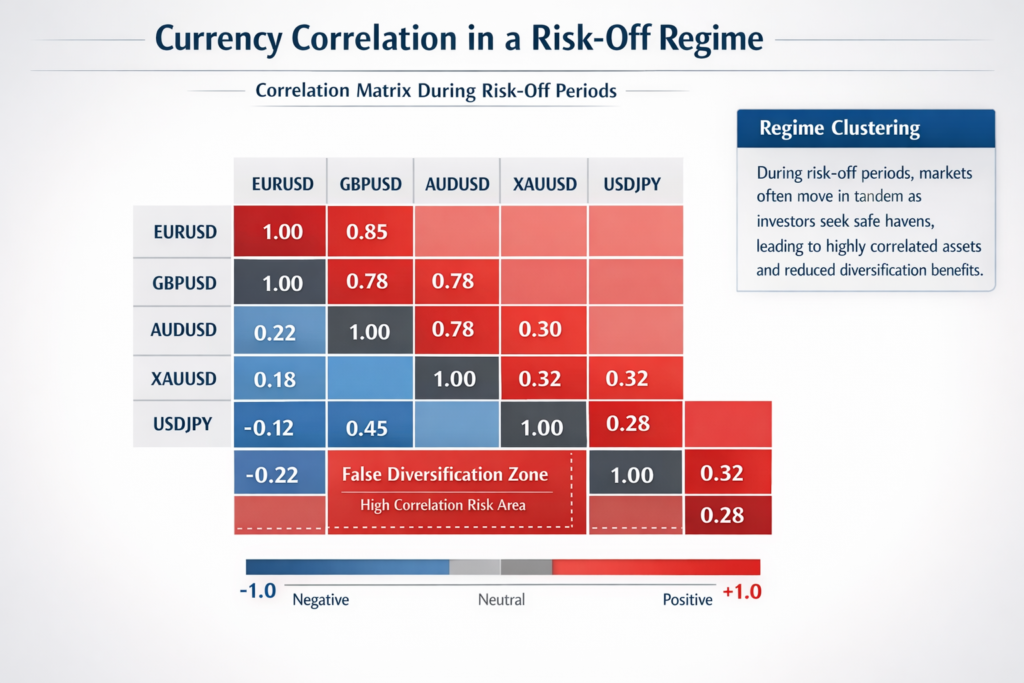
Most retail traders misunderstand diversification. They think it means trading more symbols.
The classic research by Harry Markowitz in Modern Portfolio Theory showed that diversification works when assets are not perfectly correlated. It is not about quantity. It is about correlation structure.
More recently, research published by the CFA Institute highlights that risk-adjusted returns improve significantly when portfolio construction focuses on volatility control rather than raw return maximization. For traders, that means smoothing the equity curve matters more than hitting occasional big months.
The Bank for International Settlements has also published studies showing that currency markets experience regime clustering, where volatility and correlations rise sharply during stress periods. For Forex traders, this means EURUSD, GBPUSD, and AUDUSD often behave like one trade during risk-off environments.
Meaning for active day traders:
1. Swapping three comparable pairs is not diversification.
2. Manage risk at the portfolio level, not trade-by-trade.
3. Long-term capital growth depends on drawdown control.
Portfolio structure matters more than tactical advantage for ongoing compounding.
The Trader’s Portfolio Framework
“Start small and diversify later” is not the answer to how to build a trading portfolio for beginners. Correct answer: “Structure from day one.”
This is how I deal with serious traders.
Step One: Define Strategy Buckets, Not Just Instruments
Focus on strategy, not assets.
For example:
London session trend continues. Asia represents reversion at low volatility. Trading following major news. Opening of the New York market weakens short-term strength.
Your portfolio is awful if all trades are momentum-based.
A balanced trading portfolio uses versatile strategies. Range systems can earn money when trend systems fail. Our lesson on trading major Forex news events will help breakout traders understand news uncertainty in a portfolio.
Step Two: Measure Correlation Between Your Own Trades
This is not how most traders view their transaction statistics.
Export your latest 100 trades. Group them by:
Session
Strategy
Volatile environment
Tool
One condition likely accounts for 70% of your PnL. You’re strong and weak because of that.
Balanced portfolios disperse risk across conditions, not just pairs.
If your London trend approach earns the greatest money, invest 50% of your risk budget there. The remaining half can be used to test and grow approaches that complement the first. So you don’t have to start over when trends expire.
Step Three: Allocate Risk Budget, Not Capital
This is where most traders misjudge risk.
Portfolios are based on risk, not lots.
For instance, you tolerate 1% daily risk. You might spread the 1% risk across numerous trades:
0.4 percent main strategy
0.3 percent for secondary setup
0.3 percent for opportunity trades
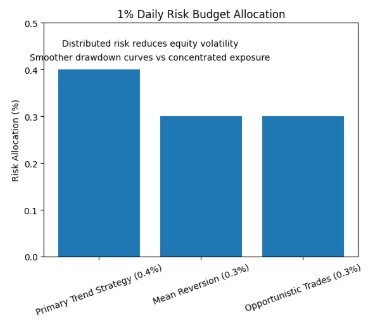
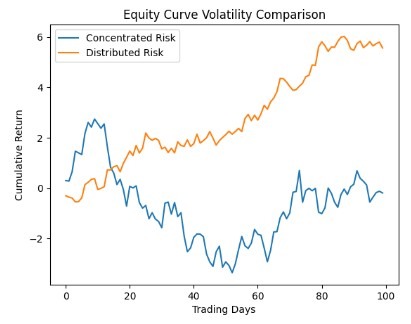
Equity changes are smoothed and mental tension is reduced.
A position size calculator eliminates uncertainty here too. Specific size prevents accidental overexposure when numerous transactions are open on correlated pairs.
Without portfolio sizing, you’re not managing risk. You reply.
When Portfolio Diversification Fails
Three places typically fail.
Too much diversity. Having many small holdings makes things more complicated and more expensive to trade. There should be no reason for a portfolio plan.
Fraud in diversification. Most trades in EURUSD, GBPUSD, and XAUUSD involve investing in the USD going up or down.
Wide range of feelings. Strategies are added during drawdowns, not improved. Not portfolio building. Avoiding.
Check out our Forex daily loss limits post if drawdowns annoy you. Portfolio structure must match daily routine.
Risk and Execution: Portfolio Thinking in Real Time
Portfolio management is crucial in high-risk situations.
Consider the situation.
You’re long EURUSD and GBPUSD before US CPI. Each trade has a 0.5% loss chance. You’re inside paper limits.
In reality, you’re betting 1% on one macro outcome.
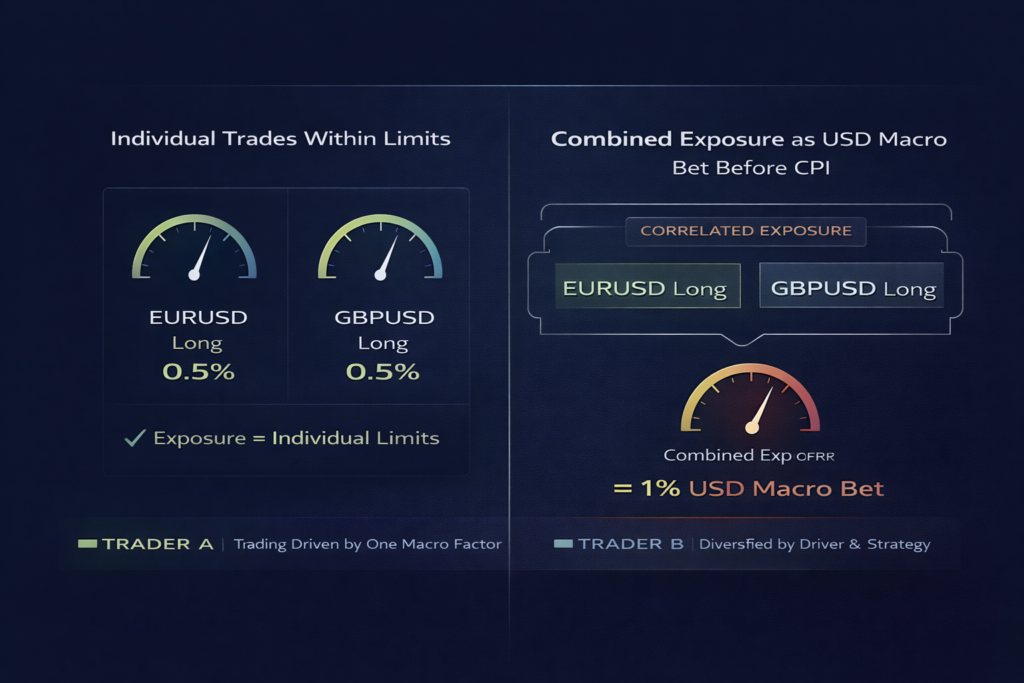
Professional traders think in exposure groupings. Retailers consider ticket size.
ahead of trading, ask “What does this add to my current exposure?”
That’s why serious traders monitor portfolio heat, not just stops.
Use the Position Size Calculator to adjust risk when correlation rises. In high-impact sessions, minimizing trading risk by 30–50% maintains more long-term capital than chasing volatility.
Journaling Portfolio Performance the Right Way
Most journals keep track of trades one at a time. Not many people keep track of how well their strategies are doing.
Your Trade Journal Template should have:
• Category of strategy
• Market system
• Correlation exposure when you enter
• Percentage of heat in the portfolio
Patterns start to show up after 30 to 50 trades.
You might find that your mean reversion trades do best when your trend strategy isn’t moving. Or that being exposed to coupled pairs at the same time lowers net expectancy.
The aim is not to make things more complicated. The goal is to be clear.
Portfolio journaling turns trading from random bets into a planned way to put money to work.
Scaling Capital Without Breaking the Structure
If you have a well-balanced and disciplined portfolio, money becomes your only obstacle.
Programs for professional evaluation help here.
The5ers, FTMO, and Topstep limit daily losses, drawdowns, and scaling. Traders consider these limits. They’re like professional portfolio constraints.
The5ers lets consistent traders steadily increase their capital. Scaling works well with a balanced portfolio. Equity curves with smoothness earn points, not spikes.
With a well-organized trading portfolio and risk awareness, an evaluation account is a good next step. Betting more doesn’t matter. Large-scale application of the same discipline.
Check out The5ers’ evaluation account to test your portfolio professionally. Reading their risk model can help you improve.
Frequently Asked Questions
How do trading portfolios differ from many trades?
Portfolio techniques and correlations reduce risk. Without a plan, multiple trades raise risk.
The number of trading strategies in a portfolio?
Most busy traders need two to four complementary approach buckets. More can disrupt concentration.
IDo day traders need to diversify their portfolios?
Yes, but it’s more important to diversify by market condition than by symbol.
How do people who are new to trading build a portfolio?
First, figure out what your main edge is. Then slowly add complementary strategies that work in different types of volatility or session environments.
Final Takeaway
To build a trading portfolio that balances risk and returns, you don’t have to trade more. It’s about putting exposure in a certain way on purpose.
Keep track of the correlation and strategy type along with the PnL for the next 20 trades. That one change will show if you are a trader with more than one setup or a portfolio manager in the making.
Next, read our guide on managing risk during the day for active traders again. Managing risk at the trade level is the first step to a balanced portfolio.