
Best Trading Podcasts for Beginners and Professional Traders
Most traders don’t lack information. They drown in it.
Podcasts are a perfect example. You listen to a legendary trader explain their edge, feel inspired, maybe even smarter, then show up the next session and trade exactly the same way you did before. No improvement. No clarity. Just more voices in your head.
The mistake is not listening to trading podcasts. It’s listening without a filter.
This guide is built on years of trading, losing money, and studying. It allows you to use the greatest trading and investment podcasts as tools, regardless of your trading level, rather than listing popular shows.
What the Research Says About Learning From Audio
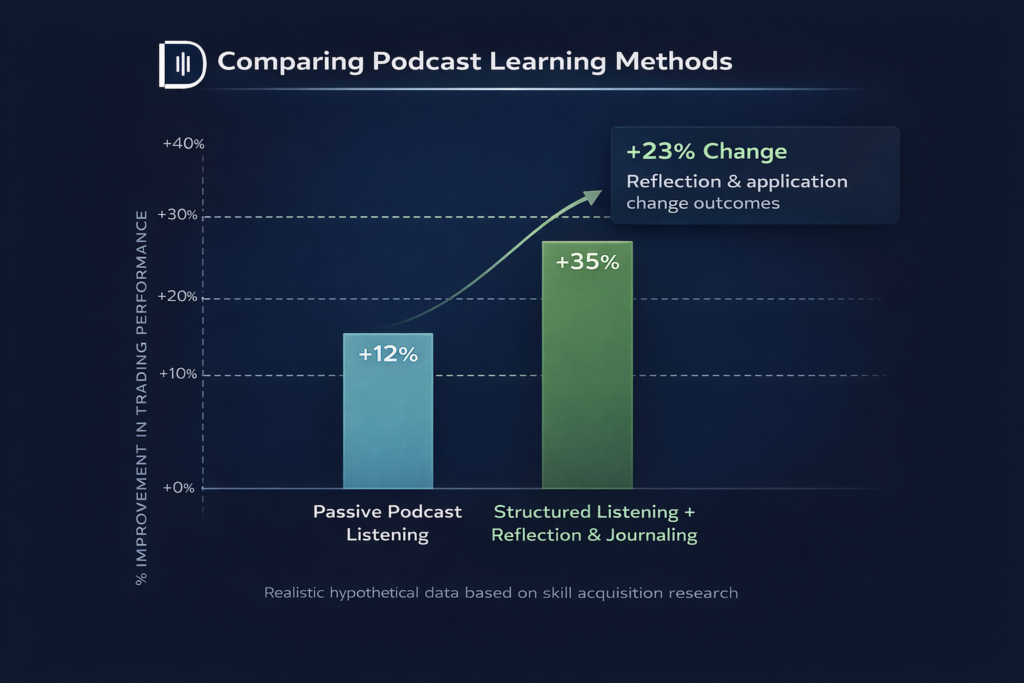
Skill development studies show that passive learning does not change achievement.
According to a Harvard Business Review study on expert growth, professionals learn best by reflecting on and applying what they’ve learned. People don’t acquire new skills via podcasts. Systematic listening does.
Anders Ericsson’s intentional practice study, cited by the American Psychological Association, give another approach. Learners become professionals by focusing on and testing subskills. Thus, traders should focus on decision grounds rather than outcomes.
In finance, narrative-based learning improves comprehension only when combined with post-learning analysis, according to CFA Institute study.
Most importantly, choose podcasts that improve your thinking, stress management, and risk-taking. Focus on improving, not being famous.
A Practical Framework for Using Trading Podcasts Effectively
Step One: Match the Podcast to Your Trading Phase
Not every podcast is good for every trader.
If you’re creating a system, listen to podcasts that talk about procedure, risk, and mistakes people make when they trade. If you know what your advantage is, watch shows that talk about how experts deal with scalability, decreases, and limited funds. Listen differently depends on your journey.
Institutional macro talks confuse execution discipline when you still struggle.
A podcast episode isn’t instructional if it gives you trading ideas but doesn’t assist you make better judgments.
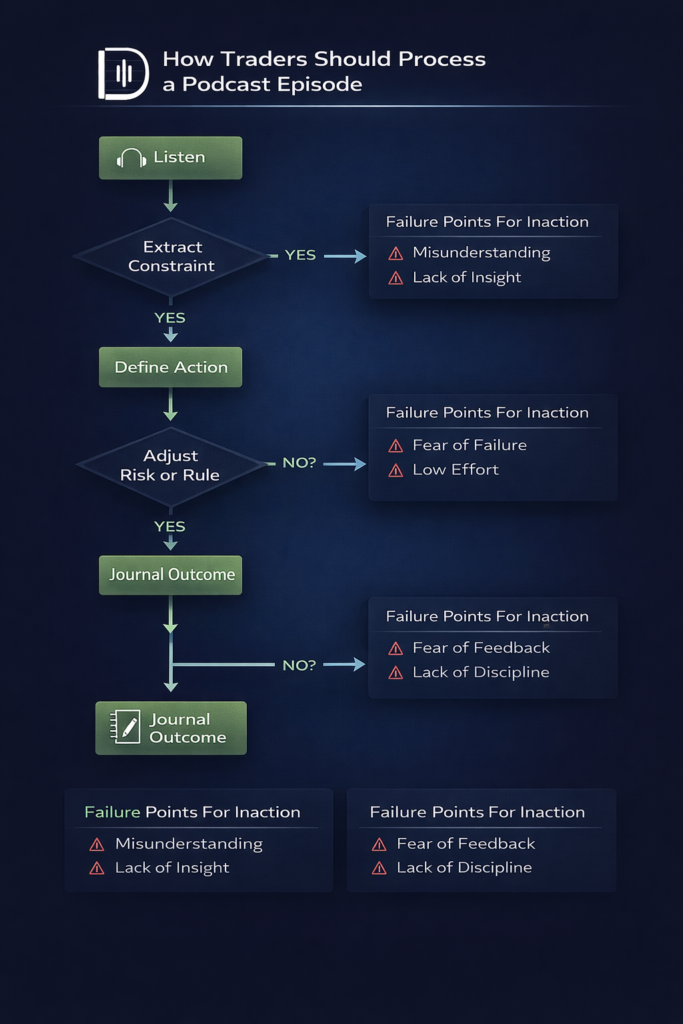
Step Two: Listen for Constraints, Not Setups
The most common mistake that new podcasters make is not following the settings.
Professional traders don’t often talk about entrances by themselves. What matters is what they won’t trade, when they stop, and when they give up.
When listening, ask,
“What would stop this trader from taking the trade?”
How do they define a bad day?
Would they defend funds or potential first?
Concentrating on constraints and decision-making might help you turn passive listening into trading improvements.
Best Trading Podcasts for Beginners
Chat With Traders
One of the best podcasts for traders who want to grow is one that talks about career paths instead of just strategies.
Why it works: You see how traders change over time, not how they got lucky.Taking risks, failing early, and having mental blind spots keep happening.
Best utilized with articles like “Developing a Trading Edge Over Time” on DayTradersDiary.com to help you connect stories with structure.
Better System Trader
This podcast shines for traders who want to move beyond randomness.
Testing, regulations, and repeatability are important parts of the podcast. Its mental models are useful for discretionary traders of all skill levels, even though they center on systems.
Listen to how rules can help traders avoid hurting themselves, not just market risks.
The Trading Psychology Podcast
Ideal for traders who know how to read charts but have trouble being consistent.
Episodes look at how to control your emotions, deal with performance pressure, and the identity traps that traders of all skill levels face. For a more in-depth understanding, it goes nicely with the DayTradersDiary.com article on emotional management and trading discipline. The greatest trading podcasts for professional and experienced traders
Macro Voices
This is not a day trading podcast, and that’s why it’s valuable.
It helps advanced traders contextualize risk and avoid tunnel vision. The key is understanding environments that favor your strategy, not trading on opinions.
Top Traders Unplugged
A deep dive into systematic and discretionary thinking at a professional level.
Best for traders who already manage risk consistently and want to refine drawdown control, diversification, and long-term expectancy thinking.
Odd Lots
For traders who want to understand market plumbing.
Key takeaway: Use insights about liquidity and leverage from these episodes to redesign your risk-management approach during market stress.
Turning Podcast Insights Into Execution Discipline
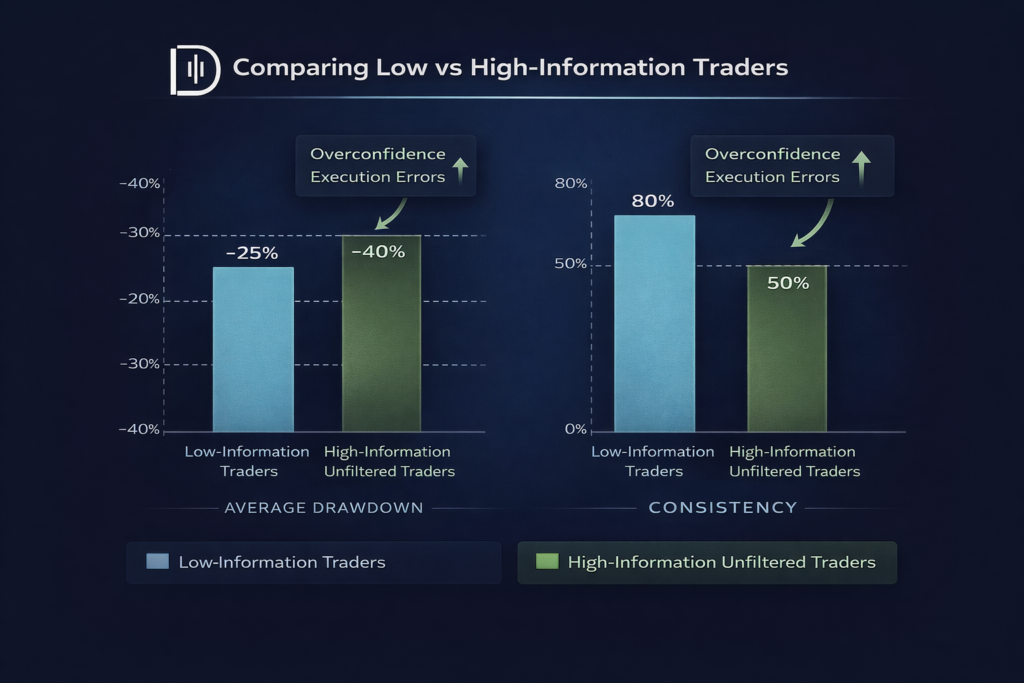
To much information without action leads to overconfidence.
Create one action item from an episode. Unupdated setup. A limit.
For example:
If a trader talks about lowering size while things are unclear, do it by making your position-sizing restrictions stricter. This is where most traders get their risk wrong. A position size calculator takes the guesswork out of the process and makes sure that knowledge and action are in sync.
Key takeaway: Let podcasts shape your trading size and timing, not just your strategies. Change your actions based on these insights.
Journaling What You Learn, Not What You Hear
Most traders record trades. Few people journal their learning.
After each good podcast episode, write:
This tested what belief?
This strengthens what rule?
This helps avoid what error?
Important: Journaling what you learnt, like using DayTradersDiary.com’s Trade Journal Template, links material to tangible advantages.Scaling the Knowledge Into Capital Growth
Eventually, learning plateaus unless capital increases.
Many disciplined traders turn to evaluation programs from firms like The5ers, FTMO, or Topstep. These provide structured environments that enforce the risk rules discussed in podcasts.
The5ers focuses on risk management, discipline, and method, all attributes discussed frequently in the best trading podcasts.
If you use what you learn all the time but feel like you can’t make any more money, getting a The5ers assessment account is a smart next step, not a risk.
Frequently Asked Questions
Which podcasts are best for beginner traders?
Enhance your focus and basic thinking with Chat With Traders, Better System Trader, and The Trading Psychology Podcast.
Are investing podcasts helpful for day traders?
However, only for context and regime knowledge, not trade signals. Avoid trading against larger forces with broad shows.
So how many podcasts should traders listen to?
Some less than you think. One or two people who listened closely and constantly applied what they learned did better.
Replace trading lessons with podcasts?
No, structured review, journaling, and experience improve them. Thoughts, not actions, improve with podcasts.
Closing: A Better Way to Listen
Make one change per month. Don’t listen to trading podcasts in free time. Schedule them like studying.
To listen with objective, find a boundary, act on it, and record what transpired. Progress begins with one action.
Next, discover how professional traders created a learning method they may apply again on DayTradersDiary.com. It links podcasting, journaling, and action to a meaningful system.