
One of the most common complaints you hear from traders trying Darwinex is this:
“I’m profitable, but my DARWIN score is terrible.”
That frustration usually comes from a misunderstanding. Darwinex is not trying to find traders who make money fast. It is trying to identify traders who can protect capital while making money slowly.
If you approach Darwinex like a typical prop firm challenge or personal account, you will fight the system. If you understand how its risk engine thinks, you can turn it into an edge.
This article is not a marketing breakdown of the Darwinex prop firm model. It is a practical guide built from trading behavior, data logic, and the mistakes traders repeatedly make when adapting to Darwinex risk management.
What the Research Tells Us About Risk Consistency
Darwinex did not invent its risk philosophy. It borrowed heavily from institutional asset management standards.
According to research published by CFA Institute on manager selection, volatility control and drawdown stability are stronger predictors of long-term capital allocation than raw returns. Investors care more about how returns are generated than how large they are.
A study by Morningstar on mutual fund performance showed that funds with lower downside deviation retained capital longer and attracted more inflows, even when their returns were not top quartile.
Darwinex applies this exact logic to retail traders. Their proprietary risk engine standardizes volatility so investors can compare traders fairly. This means two traders making 10 percent are not equal if one does it with erratic exposure and the other with controlled risk.
For day traders, this changes the game. You are no longer trading just for profit. You are trading for investor trust metrics.
How Darwinex Risk Management Actually Works
The Volatility Engine Most Traders Ignore
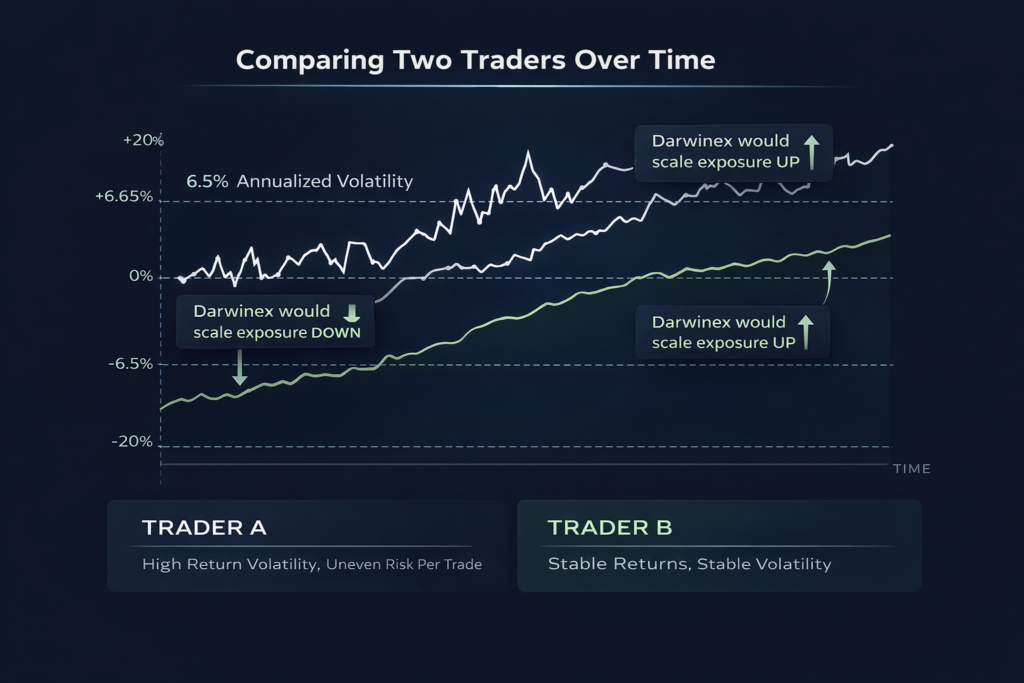
Darwinex targets 6.5% annual volatility to equalize DARWIN risk.
It indicates something simple but awkward. Darwinex will reduce your account size for aggressive trading. Trading too carefully scales you up.
Your job isn’t to maximize profits. You must perform smoothly and reproducibly after considering risk.
Lots of aggressive scalpers struggle with this.
Because of this, aggressive scalpers struggle. Win often, but visibility fluctuates. That’s instability, not skill, to the system.
Risk Stability Beats Accuracy
Many Darwinex users think win rate is everything. Not so.
Consider two traders.
Depending on his confidence, Trader A wins 70% of trades but risks 2%, 0.3%, or 1.8%.
Trader B wins 45 percent of trades but risks a consistent 0.5 percent every single time.
Trader B almost always attracts more capital over time.
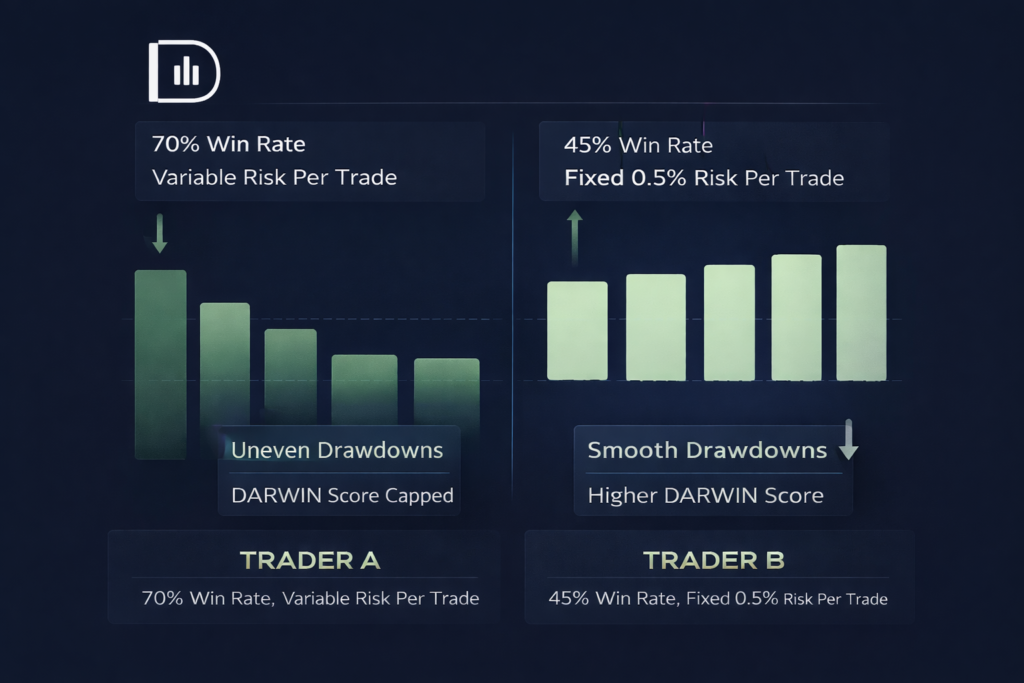
Darwinex rewards traders who behave like portfolio managers, not like signal generators.
If this sounds unfamiliar, the article on professional risk frameworks for day traders on DayTradersDiary.com pairs well with this mindset shift.
A Practical Framework to Trade Darwinex Effectively
Step One: Define Fixed Risk Units
The quickest approach to break Darwinex risk scoring is to change the size of your positions based on how you feel or how good the setup is.
Every trade should risk the same amount of money. Not close. That’s right.
This is where majority of traders get risk wrong. A position size calculator takes the uncertainty out of the equation and makes sure that your stop distance, lot size, and exposure stay the same from session to session.
Darwinex will recognize if you modify the risk for each trade.
Step Two: Reduce Intraday Risk Compression
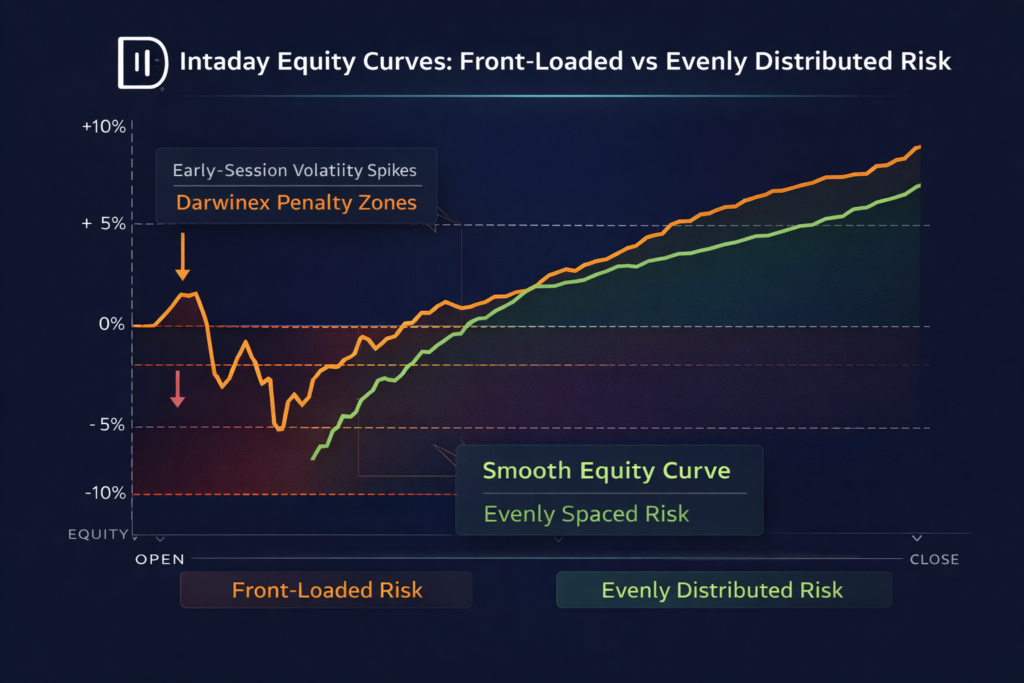
Many day traders stack risk early in the session and then go flat. This pattern’s initial instability bothers Darwinex.
Try spreading your exposure evenly across your trading window.
Example: Don’t risk 1% on the first two of four deals and nothing on the last two. You risk 0.25% on each trade. Space out the equity curve.
This can boost your DARWIN score without changing your strategy.
Step Three: Drawdown Control Is Non-Negotiable
Darwinex penalizes sharp drawdowns more than slow recoveries.
If you trade through a losing streak aggressively, your future upside is capped because the system reduces allocation potential.
This ties directly into daily loss discipline. If you want context on this, revisit the article on managing daily loss limits in Forex on DayTradersDiary.com. The logic overlaps almost perfectly.
Execution Discipline Under Darwinex Rules
Darwinex recognizes poor execution faster.
Late transactions, larger stops, and vengeance trades create instability. You may get your money back, but your risk metrics will be shattered for weeks.
Trading frequency is less significant than execution discipline. Fewer, neater transactions perform far better than more frequent, less visible ones.
Darwinex won’t forgive. It is.
Journaling for Darwinex Performance Optimization
This need more than trade journals.
You should monitor:
Risk consistency per trade
• Wins and losses affect volatility.
• Drawdown exposure behavior
Organized assessment excels here. The Trade Journal The DayTradersDiary.com Trade Journal Template tags trades by risk unit and session behavior. Within a month, Darwinex patterns are clear.
Most traders do not fail Darwinex because of bad strategies. They fail because their behavior under stress is measurable.
Scaling Beyond Personal Capital
There is a ceiling to what discipline alone can achieve if capital is limited.
This is why serious traders explore capital allocation models. Darwinex offers one path, but it is not the only one.
Evaluation-using firms like The5ers, FTMO, and Topstep have risk criteria and scaling strategies that reward compliance. Darwinex is based on investor preferences, while assessments are rule-based.
Many traders use The5ers evaluation account to focus. After that, students go to Darwinex, where achievement determines capital allocation rather than pass-fail.
Darwinex-style risk traders don’t feel constrained by decisions.
Frequently Asked Questions
Is Darwinex a prop firm?
Darwinex operates differently. It is closer to an investment marketplace than a traditional prop firm, with capital allocated by investors based on risk metrics.
Why is my DARWIN score low despite my income?
This is usually due to weak position size, volatility exposure, or quick drawdowns. Making money isn’t enough.
Can Darwinex aid day traders?
Yes, but only if they prioritize risk management over signal creation.
Darwinex money: how long?
There’s no deadline. Consistency is more significant than short-term performance increases over months.
Closing: The Real Darwinex Test
Darwinex is not testing your strategy. It is testing your maturity.
For the next 30 trading days, focus on one thing only. Make every trade risk-identical, no matter how good it looks.
If you want to go deeper, the next read should be the DayTradersDiary.com article on risk-adjusted performance metrics every trader should understand. It will sharpen how you interpret your Darwinex results and your overall trading career.