
Most Forex traders don’t blow accounts from one massive mistake. They bleed out slowly over a series of “almost good” trades on bad days.
The pattern is familiar. You start the session focused. One trade loses. No problem. Second trade loses. Still within plan. Then something subtle happens. You read higher. Just one more setup. Market uncertainty brings opportunity, you remind yourself.
When you resign, the damage is done. Not horrible, but enough to mix up the next few exercises and undermine confidence.
Losses are limited daily to prevent this. In reality, most traders set them wrong or consider them unnecessary. This guide is not about textbook risk rules. It considers actual trading behavior, performance statistics, and what keeps active day traders motivated and resilient across thousands of trades.
What the Research Really Says About Loss Limits
Academic and industry data agree on one thing. Losses cluster emotionally, not randomly.
A large study published by the Journal of Behavioral Finance showed that traders take significantly more risk after a loss than after a win, even when strategy rules stay the same. That means the danger is not the first losing trade. It’s the second and third decisions that follow it.
Broker data backs this up. According to IG Group, traders who cease trading after particular loss levels gain more than those who continue trading amid declines, even while using the identical tactics.
Another useful data point comes from Van Tharp Institute’s position sizing research, which shows that drawdown depth, not win rate, is the primary factor determining long-term survival. Daily loss limits cap drawdown velocity, which is far more important than squeezing extra trades into a bad session.
The takeaway for day traders is simple. A daily loss limit is not about limiting losses. It’s about limiting impaired decision-making.
A Practical Framework for Managing Daily Loss in Forex
Step One: Define the Day Before You Trade It
The majority of traders view daily loss as a percentage of account equity. Insufficient.
Minimum two limits:
Amount you’re willing to lose in a session• Cognitive boundary: starting point for execution quality decline
Forex traders often limit their daily account equity to 0.5% to 1.5%. Anything higher increases emotional volatility more than it increases opportunity.
The cognitive boundary is more personal. For some traders it’s two consecutive losses. For others it’s one large loss or three small ones. The key is to define this before the session starts.
If you have ever wondered why your best trading days feel boring, this is why. You respected both boundaries.
Step Two: Separate Strategy Losses From Execution Losses
This is where most daily loss frameworks fail.
Not all losses are equal.
A strategy loss happens when price does exactly what your plan allowed for and you still lose. This is normal and unavoidable.
An execution loss happens when you chase, hesitate, revenge trade, or trade outside your defined session or conditions.
Your daily loss rule should treat these differently.
Example scenario:
You take two clean losses following your plan. Market structure remains valid. Volatility is normal. You are emotionally neutral. Trading may continue.
Now consider this:
You take one loss after entering late due to FOMO. You feel frustration and immediately look for a make-up trade. That is not a strategy issue. That is an execution issue, and your day should likely end there.
This differential prevents more decline than any percentage rule.
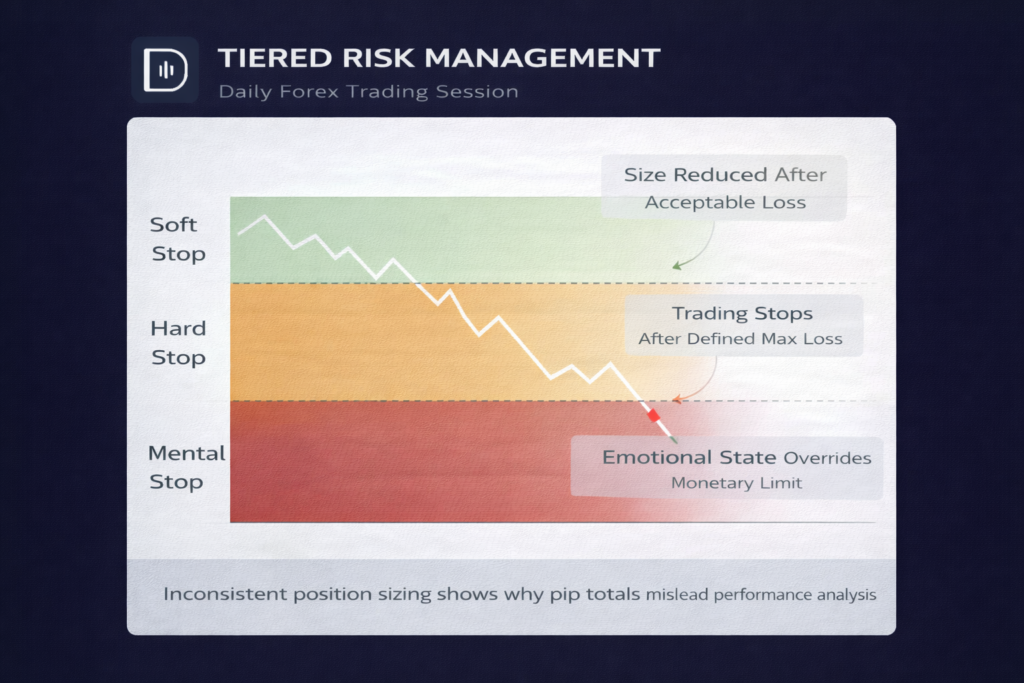
Step Three: Use a Tiered Daily Loss Limit
Traders that have been doing this for a while employ a tiered strategy rather than one hard stop.
• Soft stop: cut the size by 25% to 50% after the first lost cluster
• Hard stop: the most money you can lose in a day before trading stops altogether
• Mental stop: the point at which you stop even if the hard halt is not reached
This resembles professional risk desks. They stop more than traders. They risk more if things worsen.
DayTradersDiary.com professional Forex traders carefully handle intraday risk.
Where Daily Loss Limits Actually Fail
Trading as authorization slips doesn’t work for daily loss limits.
“I still have room to lose” is not risk management. The right to it.
You need market condition filters to use loss limits. Trending, range-bound chop, high-impact news days, and low-liquidity sessions demand different loss allowances.
Many trustworthy traders change their daily loss limits because they think things will be unclear. On slow Asian sessions, their daily loss may be half of what it is during London or New York overlap.
If you trade news-driven volatility, review the article on trading high-impact Forex news events to see how session context should influence daily risk.
Execution and Risk: Where Most Traders Miscalculate
Daily loss limits collapse when position sizing is inconsistent.
If volatility, limit distance, or tool behavior change, two “one percent” trades are different.
The majority of traders misjudge risk. Position size calculators eliminate trading risk and standardize transactions, sessions, and tools. It stops one sentimental choice from gently breaking your daily loss plan.
Daily loss restrictions are unenforceable unless you know how significant something is.
Without precise sizing, daily loss limits become theoretical instead of enforceable.
Journaling Daily Loss Performance the Right Way
Most trade diaries record PnL. Most people don’t track their drawdown decisions’ quality.
Daily journaling of three questions helps manage losses:
How did the market react to the loss limit?
Did your approach fail or did you fail to follow through?
What happened after the first loss?
Professional evaluation helps. The Trade Journal Template from DayTradersDiary.com makes tracking these patterns easier.
Behavior patterns appear after 20–30 sessions. When to halt trading will be clear.
Scaling Without Breaking Your Loss Discipline
Eventually, most disciplined traders face the same ceiling. Their edge is real. Risk management is their forte. Capital limits.
Professional traders may employ The5ers, FTMO, or Topstep evaluation algorithms. The algorithms ensure pros follow the regulations for daily losses and drawdowns, not to cheat.
To foster consistency over aggression, The5ers includes defined daily loss limits, scalability tactics, and risk parameters. Assessment accounts require daily loss traders to follow the rules, not stop them.
Instead of risking more, use a The5ers assessment account if you always make money on your own account but feel constrained by your funds.
Frequently Asked Questions
How much may Forex day traders lose?
Most active day traders do best with 0.5% to 1.5% account equity, depending on market volatility and session conditions.
If I lose one trade, should I quit?
In some cases. Stop trading after multiple losses or poor execution, not after one.
Do daily loss limits work better than weekly ones?
Daily limits control emotional spirals. Weekly limits limit structural risk. Real traders use both.
Are daily loss limits less profitable?
If your edge depends on overtrading. Stopping bad agreements raises net expectation for most traders.
Final Takeaway
Managing daily loss in Forex is not about protecting your account from the market. It’s about protecting your decision-making from yourself.
For the next 10 sessions, focus on one thing only. Define your cognitive stop and honor it, even if your financial loss limit has not been reached.