
Most day traders do not lose money because Fibonacci does not work. They lose because they treat Fibonacci retracement levels like magic price magnets instead of decision zones.
I see this constantly in trade journals. A trader draws Fibonacci on a random swing, price taps 61.8, they buy, price keeps dropping, and Fibonacci gets blamed. The real issue is context, time frame alignment, and execution logic, not the Fibonacci ratio itself.
This guide is built from years of watching intraday traders misuse Fibonacci, testing it across different market conditions, and refining when it actually gives an edge in forex day trading. You may use Fibonacci with purpose rather than optimism if you understand support, resistance, and structure.
What the research actually says about Fibonacci in trading
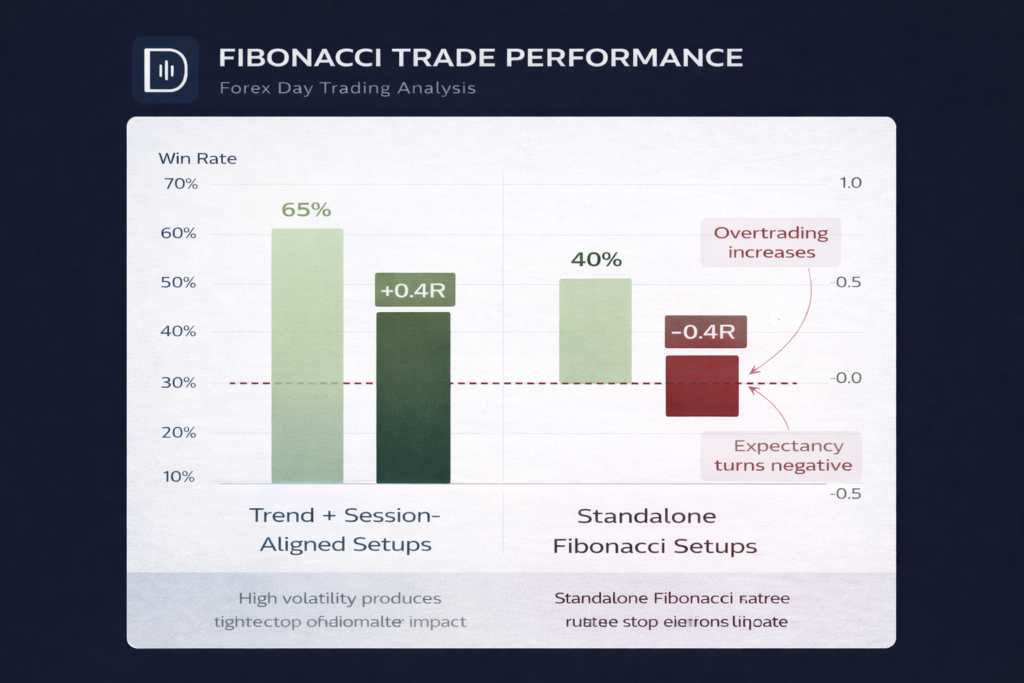
There is nothing magical about Fibonacci retracement levels. They are psychological reference points that tend to group orders since a lot of people watch the same areas.
A few excellent resources that you should really comprehend are:
In high-volume trading sessions, CME Group’s market microstructure research shows that liquidity gathers around technical levels. These Fibonacci retracement levels fit the framework.
Based on SSRN and Investopedia research, Fibonacci ratios alone are not predictive but improve with trend and momentum filters.
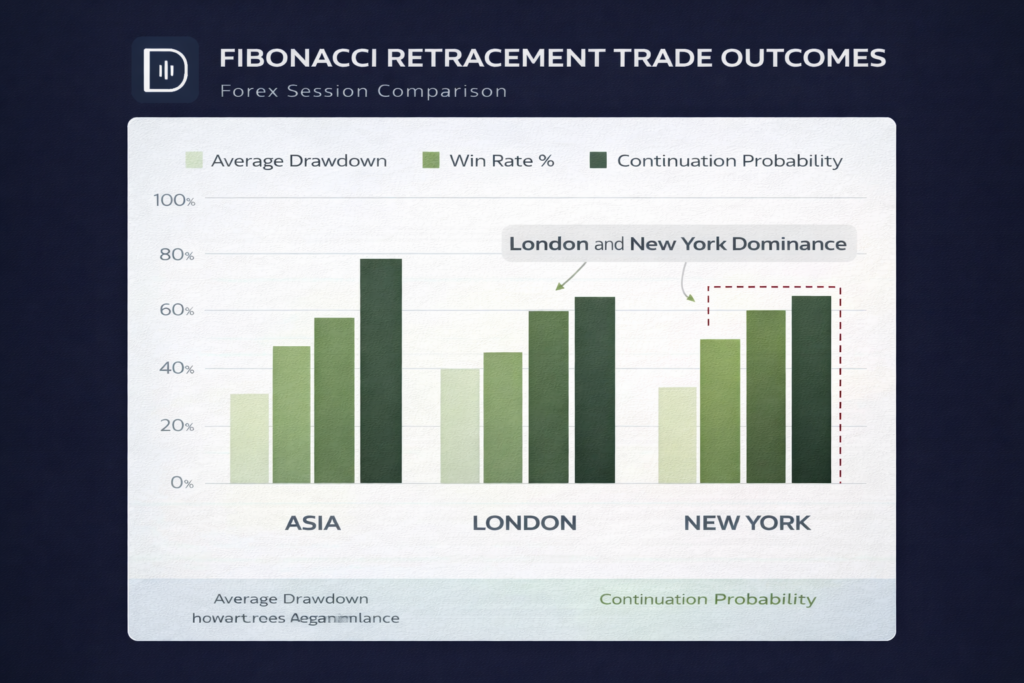
DailyFX’s institutional flow analysis reveals that retracement-based pullbacks occur frequently during hectic London and New York sessions, especially in surging FX pairings.
What this means for day traders is simple. Fibonacci works as a decision framework, not a signal. It helps you define where to look for trades, not when to click buy or sell.
If you treat Fibonacci as a standalone entry trigger, the data says you will overtrade and underperform.
What is Fibonacci in trading, explained like a trader
At its core, Fibonacci in trading is a way to measure corrective depth inside an impulse move.
In forex day trading, you are usually asking three questions:
- Is this market trending or rotating?
- If trending, how deep do pullbacks typically go before continuation?
- Where does risk make sense relative to structure?
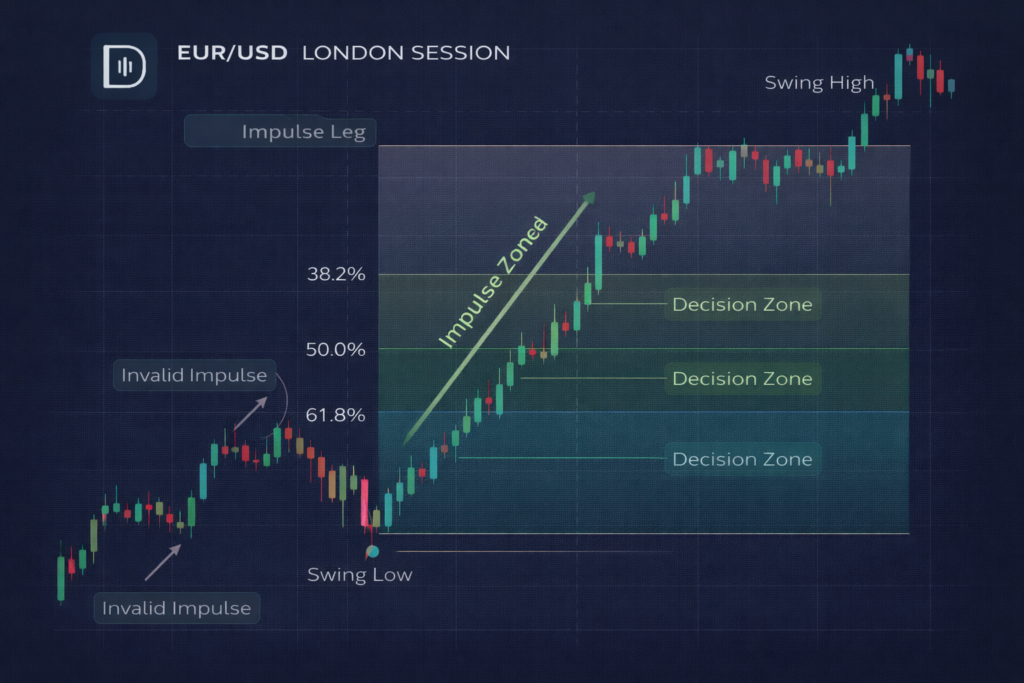
Fibonacci retracement levels help with question two. The most relevant Fibonacci retracement levels for day trading are 38.2, 50, and 61.8. Not because they are sacred numbers, but because they reflect shallow, normal, and deep pullbacks.
The Fibonacci ratio in trading becomes useful only after you define the impulse leg correctly. That is where most traders fail.
Best time frame to trade forex for beginners using Fibonacci
One of the biggest mistakes beginners make is using Fibonacci on very low time frames without higher time frame context.
Here is a practical hierarchy that actually works:
Use the 15-minute or 30-minute chart to find the impulsive action and create Fibonacci retracements.
Use the 5-minute chart to carry out and confirm your actions.
Don’t only use the 1-minute chart to draw Fibonacci unless you’re a skilled scalper with stringent rules.
This structure filters noise and aligns your Fibonacci retracement levels with meaningful participation. If you want a deeper breakdown of intraday structure, the article on market structure for day trading on DayTradersDiary.com pairs well with this approach.
A practical Fibonacci day trading framework that survives real markets
This is the framework I teach traders who want consistency, not excitement.
Step 1: Define a valid impulse leg
A valid impulse leg has:
- Clear expansion in range
- Strong directional closes
- Occurs during London or New York session, not Asian range
Do not draw Fibonacci on choppy overnight price action. That alone removes half of bad trades.
Step 2: Draw Fibonacci from extreme to extreme
In an upswing, draw a line from the swing low to the swing high. When the market is going down, draw from swing high to swing low. Many traders redraw Fibonacci mid-pullback, rendering it meaningless.
Step 3: Wait for confluence, not levels
A Fibonacci retracement level is only useful when it lines up with:
Previous high or low during the day
VWAP or the start of the session
Retest of a trendline or structural break
If the price hits 61.8 in the middle of nowhere, that is information, not a trade.
Step 4: Execute based on reaction, not touch
Price doesn’t need to reach Fibonacci levels. The price matters.
For example:
When New York opens, a large pullback candle with volume near 50% retracement indicates strong market momentum.
Price slowly rising over 38.2 without stopping usually signals a greater collapse.
Sometimes traders confuse patience with passivity. Waiting for confirmation requires patience, not instability.
When Fibonacci fails and how to spot it early
Fibonacci retracement levels don’t work most of the time in two places:
Markets that are stuck in a range with candles that overlap
Risk caused by news when the structure breaks down abruptly
If the price cuts through a lot of Fibonacci retracement levels without stopping, it means that strength is in charge. Get out of the way or switch to breakout logic.
The article on when not to trade forex intraday on DayTradersDiary.com expands on identifying these conditions early.
Risk, execution, and the part traders underestimate
Fibonacci-based trades often have tight invalidation points, which is good, but only if position size is calculated correctly.
This is where most traders miscalculate risk, using fixed lot sizes instead of adjusting for stop distance. A position size calculator removes guesswork and forces consistency when trading retracements with varying stop sizes.
The best Fibonacci traders I know lose small, consistently, and let the structure-based winners pay for it.
Journaling Fibonacci trades for real improvement
If you do not journal your Fibonacci trades, you are guessing about your edge.
Track:
- Which retracement level triggered entry
- Session traded
- Confluence present or missing
- Outcome relative to structure, not just PnL
Patterns show up fast when logged properly. Many traders discover they perform best at 50 percent retracements during London continuation, and poorly at deep pullbacks late in New York.
Use the Trade Journal Template on DayTradersDiary.com to standardize this process and remove emotion from review.
Scaling the edge when capital becomes the bottleneck
Even with a good Fibonacci-based day trading edge, your money will limit you. This is why serious traders finally use evaluation-based funding.
The5ers, FTMO, and Topstep are all firms that know what retail traders don’t want to hear. Skill and attention work when there is no constraint on capital.
The5ers evaluation program, in particular, suits traders who focus on structured, low-risk entries like Fibonacci retracements because of its emphasis on consistency and drawdown control.
If you are already journaling, managing risk properly, and executing a repeatable Fibonacci framework, an evaluation account becomes a professional step, not a shortcut.
FAQs: Fibonacci in forex day trading
Does Fibonacci retracement work for same-day trading?
Not without trend context, session time, and execution confirmation. They are unreliable alone.
Forex day trading: what is the best Fibonacci retracement?
No best level. When it matches up with other levels, the 50% retracement is often the best position to balance risk with continuation.
Is Fibonacci good for beginners?
Only if beginners first learn market structure and time frame alignment. Otherwise, it creates false confidence.
Can Fibonacci be used without indicators?
Yes. Fibonacci pairs extremely well with pure price action and structure-based trading.
Closing: one thing to improve this week
If you take one action from this article, make it this. Stop treating Fibonacci retracement levels as entries and start treating them as decision zones.
Pick one pair, one session, and one Fibonacci framework. Journal it for 20 trades without deviation. You will learn more from that process than from adding another indicator.