
Most day traders remain calm despite their emotions. They have lost control since their rules don’t mean anything right now.
No clear setup is effective. Strong trends keep on without you. Losing streaks make you less confident. Control might sometimes feel similar to being stubborn than being professional. Rule changes are possible. Growing. Profitable trading is fine.
This article is not about willpower or positive thinking. It is about building trading psychology systems that hold up when pressure rises. Everything here comes from real trading desks, trader performance data, and years of watching what actually separates consistent day traders from those stuck in cycles.
What research tells us about discipline and decision-making
Behavioural finance research has been clear for decades. Under uncertainty and stress, humans default to pattern-seeking and loss-avoidant behaviour.
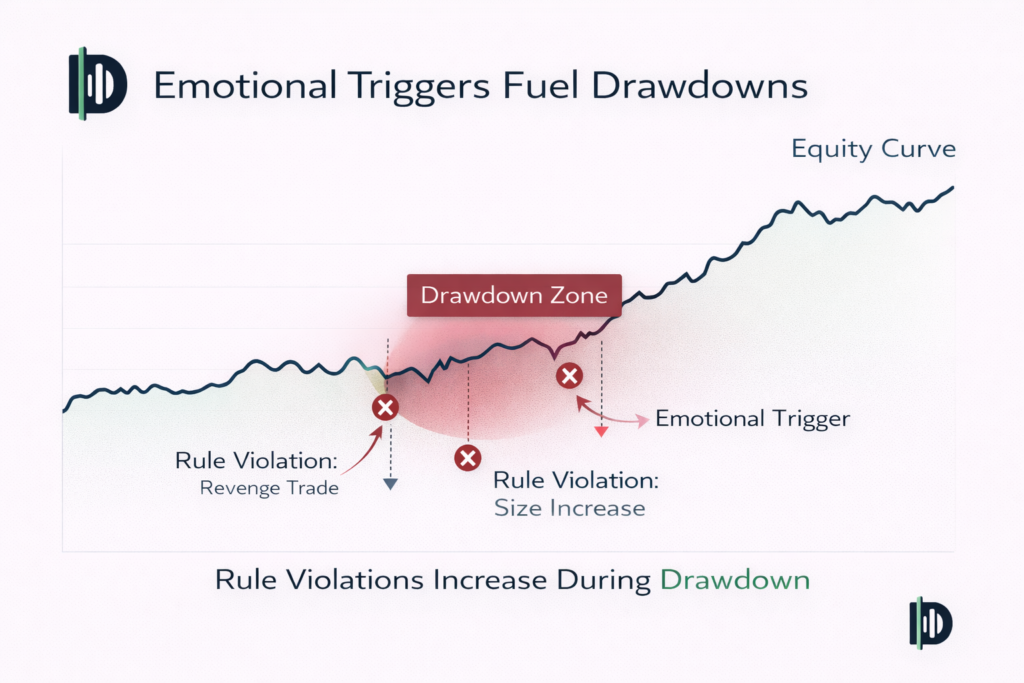
Studies by the CFA Institute and the Journal of Behavioural Finance show that traders systematically violate their own risk rules after losses, not after wins. Despite their market experience, downturns make people less focused and more inclined to make impulsive choices.
Making many important decisions in a single trading day impairs assessment, according to a Cambridge University study on decision exhaustion. This explains why discipline fails later in the session.
The lesson helps day traders. Discipline is not a personality trait. It is a structural problem. If your process relies on constant self-control, it will fail under drawdowns and volatility.
A practical framework for disciplined day trading
Professional traders do not rely on motivation. They rely on constraints.
One effective framework is decision reduction. You predefine as many choices as possible before the session starts. Market selection, session emphasis, maximum trades, and risk restrictions are set in stone ahead of time.
Specified authorization is another way to do things. You can only trade aggressively if certain conditions are met. For instance, the volume goes back to normal after the first successful transaction or gets smaller after two declines in a row.
Think about this situation. You miss a breakout when London opens. Price goes on without you. The undisciplined response is chasing. The disciplined response is knowing that missed trades are not errors unless they violate your plan. This mindset is reinforced by rules, not emotion.
This approach aligns with concepts discussed in our article on building rule-based day trading plans that survive drawdowns.
Why discipline fails even with a good strategy
The majority of discipline losses are execution errors.
Traders devise excellent methods but trade them during volatility, poor liquidity, or emotional weariness. Rules are abandoned when results differ because they feel incorrect.
Also common is outcome obsession. Not rule compliance, trading results indicate traders’ discipline. This encourages the brain to associate rule-breaking with rewards.
If you need help, see our list of intraday trading mistakes that slowly reduce profitability.
Risk control as the foundation of trading psychology
Nothing stabilizes psychology like controlled downside.
When risk is inconsistent, emotions amplify. When risk is stable, discipline becomes easier.
This is where most traders get the risk wrong. They change stops based on how they feel, but they keep the size of their positions the same. A position size calculator takes the uncertainty out of the equation and makes sure that things are always the same, no matter how volatile the market is.
Professional traders don’t use pips or dollars to measure risk; they use account %. This halts losses from being too big mentally and stops the downward spiral that makes it hard to stay focused.
Journaling for psychological performance, not just results
Most traders keep track of their trades. Less journal behavior.
Keep track of whether you follow the rules, where you feel ahead of you write, and any changes you make to your plans in your notebook. Price charts never indicate patterns.
Many traders’ worst days aren’t due to market conditions, but to emotional triggers like losing money early or missing trades.
A structured trade journal template speeds up this feedback loop and quantifies psychology.
Scaling discipline beyond personal capital
Strong psychology and discipline create an edge, but personal capital limits growth.
Strong mind and self-control are advantages, while a lack of personal capital may be a disadvantage.
Serious traders look for prop firms with assessments. The5ers, FTMO, and others encourage consistency, not gambling. Drawdown restrictions, risk caps, and process discipline are monitored.
Successful traders in these programs are professional. There are no evaluation account shortcuts. Mirrors.
If you’ve showed focus and follow-through, consider a The5ers evaluation account. It helps you scale your money without changing your habit, something many traders do badly.
Closing: one discipline upgrade that matters
The easiest way to develop discipline is to get rid of one choice, not add one restriction.
This week, think back to a period when you broke the rules a lot. Then make it smaller. Fewer trades. A smaller size. Day off hard.
Next, read our article on how professional day traders deal with slumps without declining trust.
FAQs
What is the most important day trading rule?
Always monitoring risk. Discipline without it will fail.
Learning trading psychology takes how long?
Psychology improves when decreases cause structural changes.
Do you learn discipline or is it innate?
Systems, not traits, teach it.
Why do losing traders break the rules?
Losses distract people and make them more impulsive.