
Most forex day traders do not blow accounts because they lack a strategy. They blow them because they keep repeating the same mistakes, just in slightly different market conditions.
I have seen this cycle play out for years. A trader has a decent setup, understands basic structure, and even respects risk on paper. Then a losing streak hits, confidence cracks, execution slips, and suddenly the problem is blamed on the broker, the session, or the market itself.
This article is not a list of beginner errors. It is a breakdown of the bigger, more expensive mistakes experienced forex day traders keep making, often without realizing it. These insights come from real trading data, behavioral research, and watching traders progress through drawdowns, plateaus, and eventual consistency.
If you already know how to place trades but want to stop leaking performance, this is for you.
What the Data Reveals About Trader Failure
Multiple studies paint an uncomfortable but useful picture.
The Bank for International Settlements believes that most retail forex traders fail because they trade at the wrong times and are excessively exposed during periods of high volatility, not because of the incorrect technique. The market is structured. Traders do.
An extensive CFA Institute study found that discretionary traders disregard their own rules after losing money, especially after several losses. Hope collapses here.
Broker performance records, including those from the UK FCA, show that longer-term traders trade less often and reduce their positions as volatility rises.
Human behaviour and organisation are the most significant faults, not technology. Fixing them requires systems, not incentives.
The Most Costly Mistakes Forex Day Traders Make
Mistake 1: Trading Too Many Market Conditions
Most traders think diversity means investing in several things. In reality, it means mastering one thing and avoiding the rest.
Forex markets cycle between range, increase, and compression. Many traders want the same setup in all situations. Sometimes that succeeds, strengthening evil actions.
Basic plan:
No trading or less when volatility reduces.
Increased volatility changes stops and expectations.
Be flat if the structure is obscured.
Reread our piece on day traders’ time frames and why most chose the wrong ones to learn about volatility and execution.
Mistake 2: Confusing Activity With Progress
Screen time doesn’t increase edge.
You shouldn’t assess your productivity by how many trades you make. Professional traders measure their success by following the rules and executing well.
A trader who takes three clean trades aligned with a plan is outperforming someone who takes ten impulsive trades, even if the P&L looks similar in the short term.
This mistake often stems from learning environments that reward constant action rather than structured decision-making. A true Forex trading academy should teach when not to trade just as aggressively as when to trade.
Mistake 3: Fixed Risk in a Variable Market
Markets change. Many traders do not.
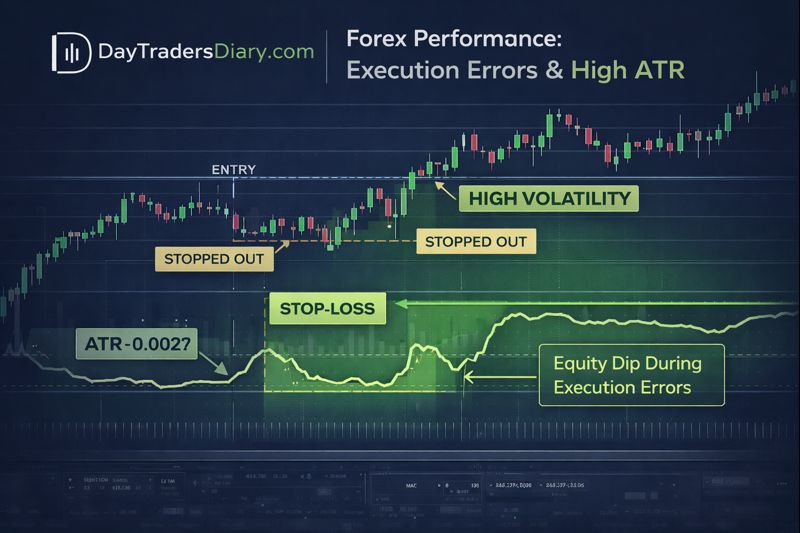
Using the same stop and position sizes across all sessions and volatility regimes is one of the fastest ways to produce inconsistent results.
This is where most traders miscalculate risk. Using a position size calculator removes guesswork and forces your risk to adapt to market conditions rather than emotions.
If your losses feel random, they usually are not. They are often the result of static risk applied to a dynamic environment.
Mistake 4: Strategy Hopping After Normal Drawdowns
Every strategy has drawdowns. Many traders interpret them as failure instead of statistical reality.
A practical rule:
If you have not logged at least 50 to 100 trades executed exactly as planned, you do not have enough data to judge a strategy.
Jumping strategies reset your learning curve and keep you emotionally dependent on short-term outcomes. This is why traders who hunt for the finest online forex trading education get stuck. Instead of skill, education without execution depth generates illusion.
Mistake 5: Ignoring Execution Errors in Journaling
Most traders’ journal. Our journals are rarely written.
Taking notes when you arrive and depart is useless. Be prepared for trouble and leave early.
Revenge deals
Patterns matter more than wins when breaking the rules after losing. A structured Trade Journal Template simplifies the implementation of the concept.
A Practical Framework to Avoid These Mistakes
Instead of attempting to cure everything, concentrate on controlling the process.
Before you start trading each day, ask yourself three questions:
Is it a good day for my setup to trade?
What is the most I can lose today?
What acts would invalidate my session regardless of P&L?
You only have to keep your word throughout the session. Just review after the session. Mixing them breaks order.
This framework is expanded further in our guide on how to build a simple day trading plan that actually works, which pairs well with this article.
Risk and Execution Are the Real Edge
Day traders in forex assume risk management means not losing money. Maintaining performance is crucial.
Trading skill depends on risk. Overpositions impede thinking. Bad risk kills good setups.
While making mistakes, position size calculators help you stay consistent. Experts are using tools because people can’t do all.
Journaling as a Performance Weapon
Every week, your diary entries should answer this question:
Do you lose money in stocks?
Performance monitoring makes growth automatic. This helps traders stay active.
Writing in a boring way often reveals hard truths. Get used to being uncomfortable. Edge lives there.
Scaling, Capital, and Professional Pathways
Even the most dedicated traders will eventually lose money.
Expert assessment programs help. The5ers, FTMO, and others offer structured trading paths for those willing to take on risk.
Serious traders use assessment accounts to prove their worth, not for money. Their plan exists. The test simply ensures that the approach works under tougher conditions and a larger notional size.
If you’ve fixed the challenges in this post and are performing well, acquiring a The5ers assessment account is sensible.
Closing: One Mistake to Fix This Week
Avoid correcting every mistake at once.
Focus on one this week. Trade less, normalise risk, or report execution faults. Narrow concentration accelerates growth.
Most forex day traders lose because they refuse to simplify, not due to the market is challenging.
As a next read, revisit our article on day trading vs gambling to reinforce the mindset shift that separates professionals from participants.
Fix the process. The results will follow.
FAQs
What is the biggest mistake forex day traders make?
Overtrading during unsuitable market conditions while using fixed risk in a variable environment.
Do most forex traders fail because of their strategy?
No. Most fail due to execution errors, poor risk control, and emotional decision-making.
Profitable forex trading school?
Only if it promotes dedication, journaling, and risk-taking over method change.
Regular trading errors: how difficult to fix?
Within weeks, effective tracking can indicate cognitive alterations. Long-term progress takes months of effort.
Helping disciplined traders with prop firm reviews?
Yes. Cash and success proof are given to traders by assessment accounts.