
How to Calculate Risk Per Trade in Forex (Step by Step)
Most blown trading accounts do not fail because of bad analysis.
They fail because the risk was miscalculated long before the trade was placed.
After reviewing thousands of day trading journals over the years, a consistent pattern emerges across all skill levels. Traders believe they are risking 1 percent per trade, but in reality, they often risk far more due to incorrect position sizing, stop placement, or execution costs.
These traders usually understand the basics. They know what a stop loss is. They understand risk-reward ratios. What they struggle with is translating theory into execution-grade decisions under real market conditions.
This guide is based on real trading behavior, drawdown data, and post-trade analysis. It talks about how risk per trade really works in real forex markets, not how it is written about in books.
This is where risk per trade stops being an abstract idea and becomes a useful way to control your trades if you are an active day trader who wants to stabilize your equity curve and get through losing streaks.
What Research Says About Risk Per Trade?
Institutional and academic research consistently demonstrates that position sizing decisions account for greater long-term performance variation than entry accuracy.
Research published in the Journal of Finance analyzing professional money managers found that volatility in returns was more closely linked to capital allocation than to signal quality. SSRN studies on retail FX traders show that traders who exceed fixed fractional risk thresholds experience exponentially larger drawdowns, even with profitable strategies.
The Bank for International Settlements has also pointed out that leverage makes mistakes in short-term FX trading worse, especially during times of high volatility when slippage and spread expansion make risk seem higher than it really is.
This information is very clear for day traders. Most accounts don’t fail because the strategy stops working. They fail because risk slowly grows when things are stressful, after losses, or when they are sure they will win. When the risk per trade is not the same every time, expectancy falls apart.
The Core Framework: Risk Is Defined Before the Setup
One change in thinking sets stable traders apart from those who aren’t.
Risk per trade isn’t a percentage.
It is a set decision boundary.
Professional day traders do not ask how much they can make on a trade. They ask how much they are willing to lose if the idea fails and whether they can survive a sequence of losses without emotional or capital damage.
Step 1: Define Maximum Account Damage Per Trade
For most active day traders, sustainable risk typically falls between 0.25% and 1% per trade. Consistency is more important than the exact number.
If you put 1% of your money at risk on one trade, 0.5% on the next, and 2% on a setup you are very sure of, you are no longer using a system. You are trading discipline that looks like discretion.
Risk must be set, known ahead of time, and used the same way in all setups of the same quality. This principle aligns closely with the risk rules discussed in our article on daily drawdown limits for day traders.
Step 2: Stop Loss Distance Comes From Market Structure
This is where most forex risk calculations fail.
Many traders choose stop losses based on comfort, round numbers, or the position size they want to trade. That logic is reversed.
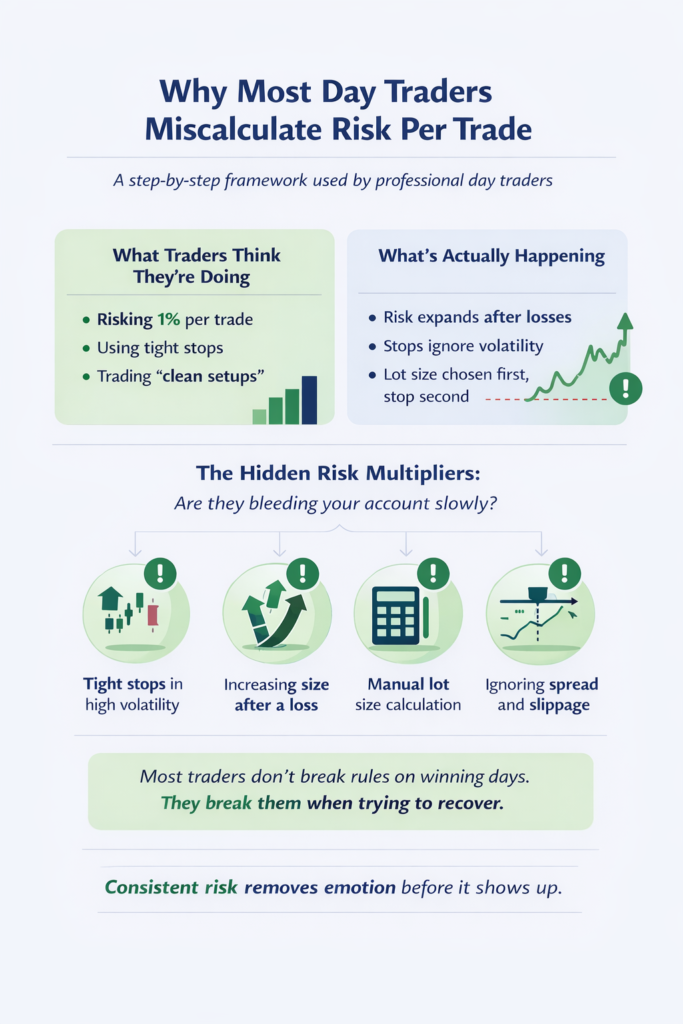
A stop loss should be determined by market structure. This includes session volatility, technical invalidation, liquidity zones, or higher time frame levels. Once the stop distance is defined, position sizing becomes a mechanical process.
If a setup requires an 18-pip stop to remain valid, that is the cost of the trade idea. Shrinking the stop to trade a larger lot size undermines the strategy itself.
This mistake is especially common during overlaps between London and New York, and is explored further in our article on why tight stop-losses fail in day trading.
Step 3: How to Calculate Risk Per Trade Correctly
Once three variables are fixed, the calculation becomes straightforward.
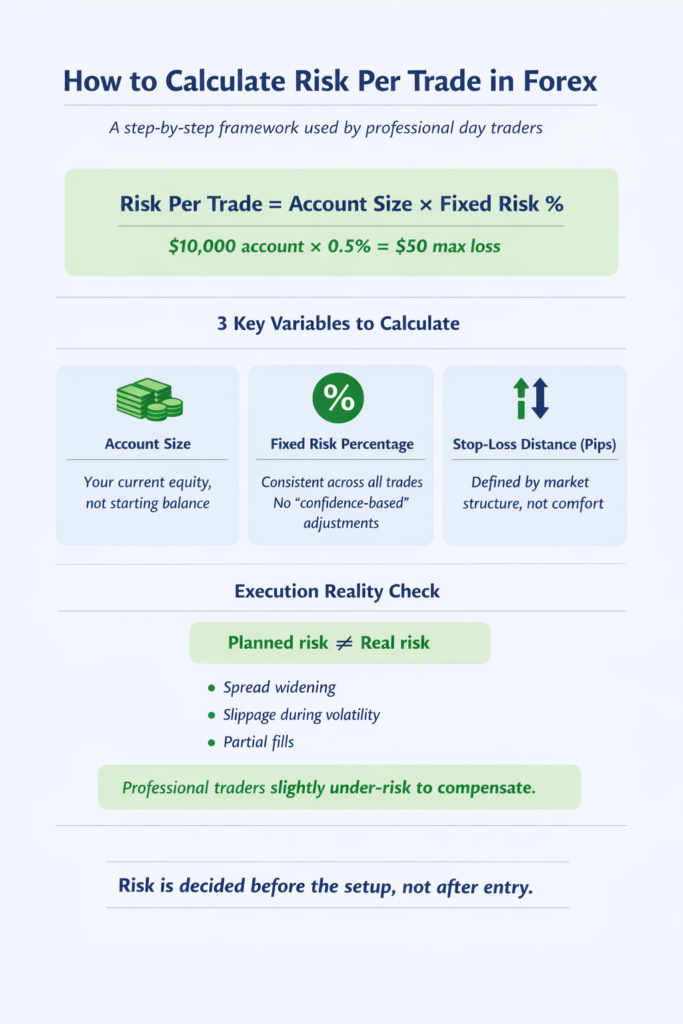
You need to specify your account size, your fixed risk percentage, and your stop-loss distance in pips.
Example:
Account size: $10,000
Risk per trade: 0.5 percent or $50
Stop loss distance: 20 pips.
This means you can afford to lose $2.50 per pip. Your position size must be adjusted to match that pip value.
This is where most traders miscalculate risk. Estimating the size of a lot by hand under pressure causes mistakes. A position size calculator takes the guesswork out of trading and keeps risk steady, even in emotional or fast-moving markets.
Risk Is Not Static: Execution Changes Real Risk
Even if the calculations are perfect, execution can change the real risk.
Wider spreads at the start of a session, slippage during volatile moves, and partial fills all add to the realized loss beyond the planned risk. Professional traders deal with this by taking on a little less risk, not making full-size trades during times of high impact, and keeping track of their realized risk compared to their planned risk in their journals.
This execution-aware approach is discussed in more depth in our guide on execution risk in day trading.
Journaling Risk to Improve Performance
Most traders journal outcomes. Few journals risk accuracy.
To improve performance, traders should track intended risk per trade alongside actual realised loss or gain. This includes noting slippage, stop placement logic, and emotional state before entry.
A structured trade journal template can help you see patterns that you can’t see when you only keep track of wins and losses. Over a sample of 50 to 100 trades, the majority of performance issues can be attributed to risk inconsistency rather than deficiencies in strategy.
Scaling Beyond Personal Capital Limits
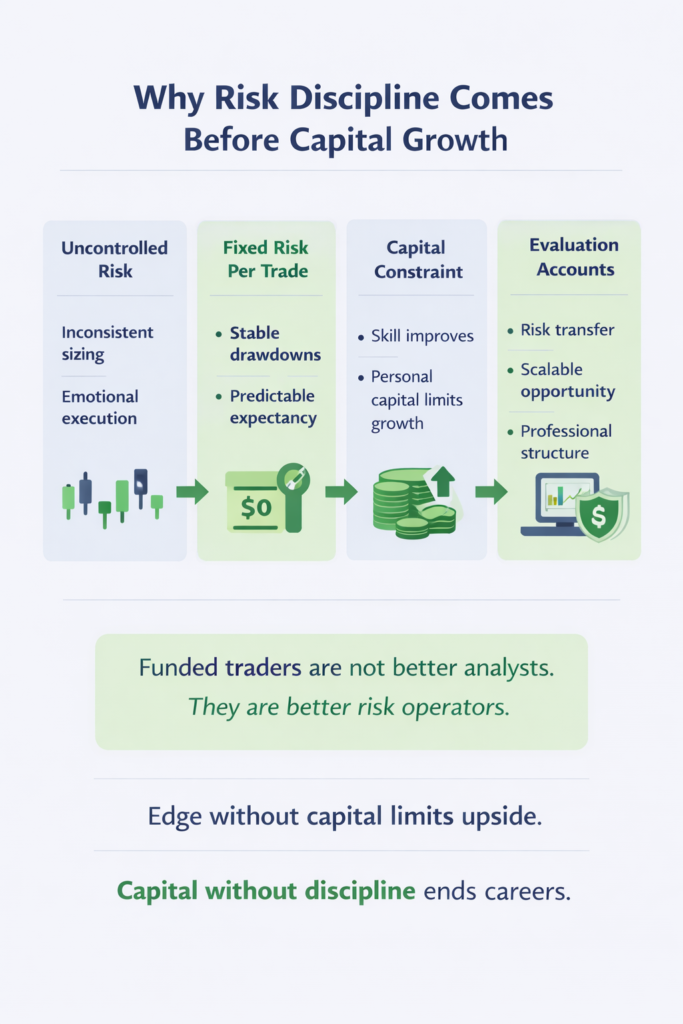
Once you control the risk per trade, a new limit shows up. Not skill, but capital becomes the problem.
This is why serious traders consider evaluation programs such as The5ers. These programs allow traders with proven risk discipline to scale without increasing psychological pressure or personal financial exposure.
Professional traders use evaluations as risk transfer mechanisms. If a trader cannot pass an evaluation with strict risk rules, it often reveals unresolved discipline issues rather than a lack of strategy edge.
For traders who have stabilized their risk per trade, exploring a The5ers evaluation account becomes a logical step toward professional growth.
A Practical Challenge for the Next 20 Trades
Set a fixed amount of risk for each of your next 20 trades, only use stop losses that make sense in the market, mechanically figure out how big your position should be, and keep a journal of your planned versus realized risk.
Don’t change your plan. Don’t change the indicators.
You have found the real performance lever if your equity curve becomes smoother. Your journal will show you exactly where discipline breaks if it doesn’t.
For deeper insight, read our next article on how professional day traders think in R-multiples rather than pips or dollars.
FAQs: Risk Per Trade in Forex
What is the risk per trade in forex day trading?
Risk per trade is the fixed percentage or amount of account equity a trader is willing to lose if a trade hits its stop loss.
What is the best risk per trade for day trading?
Most professional day traders risk between 0.25% and 1% per trade, depending on the frequency and volatility of the trade.
How do you calculate forex risk per trade?
Forex risk per trade is calculated by multiplying account size by risk percentage, then dividing that amount by the stop loss distance in pips to determine the correct position size.
Should risk per trade change based on setup quality?
No. Changing risk based on confidence makes things unfair. Setup filtering must occur before execution, but risk should stay the same.
Is 2% risk per trade too high for day trading?
Yes, for most day traders. A 2% risk greatly raises the chance of a drawdown during losing streaks.
Do funded traders calculate risk differently?
The calculation is the same, but funded traders must adhere strictly to maximum drawdown and daily loss limits.